
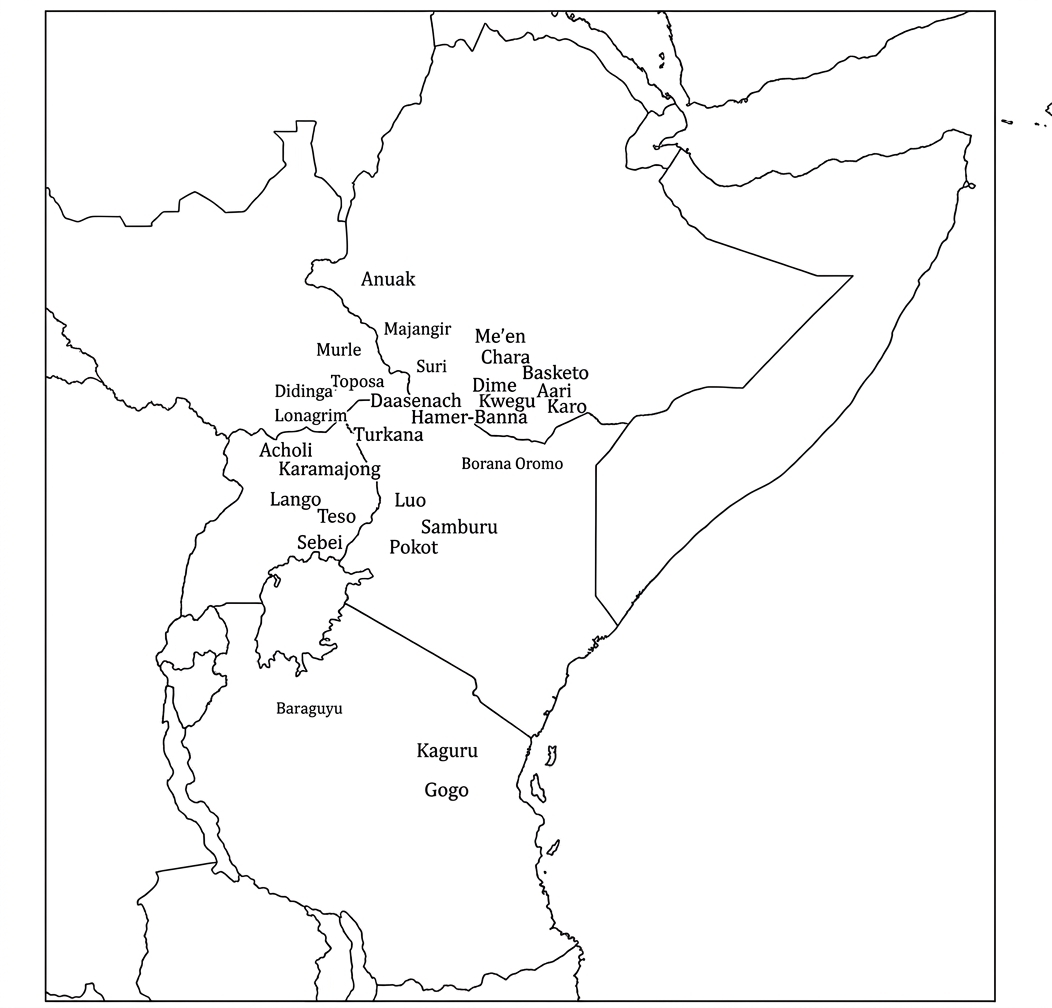
1. Distribution of sandal divination
Throughout history, societies across the world have practiced divination to know the future, such as in ancient Greece (Johnston and Reynolds 2009), ancient Egypt (Quack 2006), the ancient Near East (Jeffers 2007), early China (Flad 2008), ancient Mexico (Frassani 2005), ancient Europe (Murray and Murray 1988), and Mesopotamia (Rochberg 2004).
In the Judeo-Christian traditions, there are repeated prohibitions against Jews engaging in divination. There was a specific command to Jews to do divination only with two unique objects called the urim and thummim (Exod 28:30; Lev 8:8). In Acts 1:26, there is a single, very brief mention of casting lots. With no scriptural basis, some have done divination using the Kabbalah, others a Bible in bibliomancy, turning to a random page.
In the title of their article, Boyer and his coauthors asked, “Why divination?” People use divination for a wide variety of purposes, including “the proper place to build a house, the best day to celebrate a wedding… the right time to go to war…the choice of political officers… to hunt in particular places, and the appropriate way to deal with misfortune” (Boyer et al. 2020, 100). People use divination to give them information about things they could not acquire by natural means.
People have used a wide variety of techniques and means to divine. Haruspication, the study of entrails, was done by ancient Etruscans and is still practiced in some parts of Africa today (Abbink 1993; Karani 2023, 126). The English Wikipedia page “Methods of divination” lists more than two hundred named types of divination. Very recently, someone has coined the term “aiomancy,” “divination by artificial intelligence.”
This article describes the distribution of sandal divination, a type of divination found only in limited areas of Africa. Other methods of divination are also found in these communities. For example, divination by reading entrails is practiced in the Horn of Africa (Otto 2004, 170; Hazama 2010, 165; Karani 2023, 126).
In a number of ethnic communities across eastern Africa, people have practiced divination by throwing sandals and interpreting the way they fall. In his foundational book African Divination Systems, Philip Peek introduced the phrase “East African sandal divination” (Peek 1991, 12).
The context of that phrase shows that sandal divination was not his focus. Nowhere else in his book did he make any additional mention of divination by sandals. He did not mention any specific ethnic communities that practiced sandal divination, nor did he describe how it is performed in any community, nor did he cite any literature on the subject. Neither Google nor Google Scholar shows any other instances of “East African sandal divination.”
In a later book that contained a chapter on divination, Mack wrote, “The parts of East Africa that I know best rely on interpreting the marks left in sand by tossing a pair of sandals in the air” (Mack 2000, 34). Like Peek, he mentioned no specific locations or ethnic groups, only “East Africa.”
Documentation of sandal divination in a wide area of Africa is summarized here; most of these communities live in eastern Africa. Data documenting the practice in many specific ethnic groups are presented. Some authors mention it in more than one community, including Driberg (1923), Tippett (1970), Goldschmidt (1986), and Otim (2016).
The contribution of this paper is to bring together the documentation that sandal-throwing divination is found in more than twenty ethnic communities of eastern Africa and beyond, a much larger number of groups than had been documented previously. The focus of this article is to document the many groups that have used sandal divination, not to analyze the procedure in depth.
Below, I have arranged ethnic groups by country, though I know that this is not a fully satisfactory arrangement. Ethnic groups overlap national borders. Also, there are disagreements as to the division of language and ethnic groups. I have mostly used the labels that were used by authors. Nothing in this paper should be seen as a definitive statement about language and ethnic group divisions and boundaries or about the location of any named group.
1.1. South Sudan
Sandal divination is documented as having been practiced by at least three ethnic communities in South Sudan.
Among the cattle-keeping Toposa of South Sudan, the act is described as follows: “divination is nyakiramḁ ŋamuku̥ (in simplified writing: nyakiram ngamuk) = ‘hitting sandals/shoes.’ Some diviners use special-purpose/dedicated sandals, others use just any that’s available. The term for this type of specialist is nyekalamalam and the term for the sandals is ngamuk nakilamilamet” (James Lokuuda Kadanya and Martin C. Schröder, pers. comm., 2023).
The Murle are also cattle keepers. Their traditional practice of sandal divination has been documented by Jon Arensen and Richard Lyth (Arensen and Lyth 2011, 19–28) and Lewis (1972).
Their description includes a mention of repeating the throwing of the sandals three times when the result is unsatisfactory (Arensen and Lyth 2011, 20). Lewis wrote, “The sandal diviners are most common, because nearly all Murle know something of their art. Briefly, the procedure consists of taking a pair of sandals, putting them sole to sole, and holding them by the heels. They are then tapped two or three times on the ground and tossed quite gently into the air. This is repeated several times, and the art is to be able to read the answer revealed by the pattern in which they fall” (Lewis 1972, 139).
Andreas Kronenberg described divination among people he referred to as “Didinga-Longarim.” Some scholars refer to them as separate communities, based on cultural and linguistic criteria. Both are geographically, linguistically, and culturally close to the Murle. Kronenberg briefly described a method of orakel ‘divination’: “Throwing a pair of sandals into the air and interpreting the outcome of a planned undertaking from the way they fall” (Kronenberg 1972, 151).
1.2. Ethiopia
Alan Tippett did pioneering research in 1968 among some ethnic groups of southwest Ethiopia that were still quite isolated from the national mainstream. He was the first to document sandal divination among four ethnic groups, noting it among the Anuak, Majang, Tishena (Me’en), and Daasenach (Tippett 1970).
Sandal divination has been described in additional[1] ethnic groups in Ethiopia, all in the southwest region of the country. The definitions and division among ethnic groups are not always clear or agreed upon. Also, some of the published sources mention groups without clarifying precisely which groups practiced sandal divination. All of these groups are in the Omo Valley except the Majang and the Anuak. Also, the Anuak live on both sides of the border between Ethiopia and South Sudan.
The majority of the Anuak people live on the Ethiopian side of the Sudan border. Alan Tippett said, “The Anuak uses some piece of leather (ajua) from which to ascertain” answers to questions (Tippett 1970, 173).
The Majang(ir) people have also practiced sandal divination. They live in southwest Ethiopia, extending from the Anuak in the northwest down toward the Me’en. “The Masonga diviner (ngay), usually female, uses an instrument called a nyirukan, made from two pieces of buffalo hide joined by a metal ring” (Tippett 1970, 173). In the 1990s, Majang friends told me that divination had been practiced by throwing sandals, using ʃààmɛ́j, an Amharic loan word, the standard word for ‘sandals/shoes.’
Among the Kwegu people of the Omo Valley, Buffavand mentioned sandal divination. In describing a diviner in action, she wrote, “His divination was based on throwing miniature ‘sandals’ and interpreting their respective position” (Buffavand 2018, 143). She also included a photo of a diviner and his miniature set of sandals.
The Dime people, living south of the Omo River, have also practiced sandal divination, first documented by Todd (1977). He reported:
There are two very reputable “Garu Bab’s,” who are consulted by Dime on matters of national importance. Both are non-Dime, and resident in other countries. They divine by throwing a pair of sandals, a method which is usually associated with the western neighbors of the Dime, the Bodis. (Todd 1977, 194)
Writing about the two non-Dime diviners he had seen, Todd noted that “One of them lives in Basketo, one and a half day’s walk to the east, and the other in Ch’ara, two days to the northwest” (Todd 1977, 194).
The Me’en are composed of two branches, the lowland Bodi and the Tishena, living on higher land, farther from the Omo River. Tippett reported that among the Tishena, a “diviner uses four pieces of hide (either elephant or cow) which he casts on the ground and observes the pattern of their fall, which then has to be interpreted to the satisfaction of the spectators” (Tippett 1970, 174). This description of sandal divination among the Tishena differs from the others in that the diviner throws four pieces of leather, not two. Tippett did not mention if the pieces of leather were associated with sandals.
Abbink described a divination session among the Suri, where a diviner said, “Now, grab a shoe (a pair of leather sandals are used in divination) for me” (Abbink 2021, 297). Abbink has also reported that “Among Suri divination techniques are the interpretation of bird song and flight, the throwing of small wooden sticks, sandal throwing, and the reading of (cattle) entrails” (Abbink 1995, 326). The Suri that Abbink describes are the Suri found in Ethiopia, speaking a Southeast Surmic language. They are not to be confused with the group sometimes referred to as “Suri” in South Sudan, speaking a Southwest Surmic language (Unseth 1997).
Among the Kara (Karo) of the Omo Valley, “The preferred method of divining, casting sandals on the ground and reading their position, was thus largely the monopoly of one specific man, an unreliable but highly entertaining curmudgeonly figure” (Girke 2018, 199).
The Hamar people of southwest Ethiopia also have a tradition of sandal divination. “For the ‘sandal oracles’ a pair of miniature ‘sandals,’ i.e., pieces of leather in the shape of feet, is thrown and the practitioner’s interpretation is based on how they fall” (Strecker 2013, 100; 2023, 143). Strecker also wrote, “a diviner has settled down to throw sandals in order to ask questions… He asks his questions either directly or in the form of propositions, which the sandals may either confirm or reject, depending on the way they fall to the ground” (Strecker 2013, 100). “The sandals ‘speak’ and provide information on which the elders will act” (Strecker 2013, 100).
“Diviners (moara) in Bashada and Hamar claim to have the ability to find out the causes of disease and other individual or community level misfortunes by tossing a pair of ritual leather sandals (locally called dunguri) and interpreting the way they land on the ground” (Epple 2020, 343n9). The Bashada and Hamar have different ethnic identities, but understand each other’s speech, though there is some consciousness of difference. “Differences between Hamar, Bana, and Bashada are only very slight and are restricted to some dialectal variations of the language … as well as some variants in the course of several rituals” (Strecker 2013, 103).
The Banna live next to the Hamar. Masuda gave only one sentence about Banna divination: “When a war breaks out or the Banna decide to raid an enemy, they choose an arti [war leader] by divination using two pieces of goatskin” (Masuda 2009, 59). Given the sandal divination among their neighbors, this reference to “two pieces of goatskin” appears to be a reference to this method of divination.
Melesse Getu Kettele made a passing reference to a “sandal oracle” among the Tsamako (Melesse Getu Kettele 2000, 101).
Carolyn Ford, a longtime missionary in Ethiopia, wrote to me, “it seems to me the Aari had a tradition to do with sandals” (Carolyn Ford, pers. comm.).
The Rendille live on both sides of the Ethiopia-Kenya border. They have traditionally been pastoralists. They are neighbors of the Turkana and Borana. “[T]he Rendille have diviners (moro) who throw shoes and read intestines” (Fratkin 1991, 331n2).
1.3. Kenya
Sandal divination has been described among some groups in Kenya, most in the northern and western areas of the country.
Among the Turkana, multiple authors have mentioned sandal-throwing divination. “The diviners would throw sandals in the air and could be able to foretell the future by looking at the way the sandals fell on the ground” (Juma 2009, 176). Gulliver wrote of “Divination by throwing sandals, a technique known to many Turkana” (Gulliver 1958, 910).
Sakumichi wrote of a Turkana man with “a talent for divination and … as a diviner (casting sandals)” (Sakumichi 2011, 240).
“Some men are said to be able to do fortune-telling by casting sandals: if the tossed sandals land top sides facing each other, it is believed to represent a grave and indicate that someone in battle away from home has been killed” (Donley 1976, 39).
“The power of diviners to foretell the future is understood to come to them through dreams, through the tossing of sandals, or from reading the entrails of animals” (Sobania 2003, 39).
Sandal divination was “a common religious practice” among the Borana and other groups in the area (Mwakikagile 2014, 28). In a fictionalized biography about a young Borana woman, Mann wrote of a venerable sage known for “his skill with the throwing of sandals.” A younger person said, “it took me seven years to learn all that pertains to this form of divination… throwing two sandals upon the ground” (Mann 2008, 29).
The Daasenach (Guleb) people live in far northern Kenya and on the northern side of the Ethiopian border. “In Guleb [n.b.=Daasenach] country I met ‘the man with the shoes’. He throws a pair of shoes on to the ground and interprets the position of their fall. Here again the fall must be interpreted to the satisfaction of the spectators” (Tippett 1970, 174). Houtteman also described sandal divination among the Daasenach. A “way to divine is through throwing of sandals or necklaces. I was told that sandal-throwing is learned from the Nyangatom while the throwing of necklaces came from the Arbore [of Ethiopia]. Most of these diviners are male” (Houtteman 2014, 133). Sandal divination among the Daasenach is also described by Almagor (Almagor 1987, 19–23).
Among the Meru of central Kenya, when divination was needed to identify a person who was responsible for a problem, a diviner practiced “Detection by leather, using two strips of cowhide called ‘sandals’” (Fadiman 1977, 100n9).
Among the Pokot (western Kenya, eastern Uganda), Ndege wrote of their “institution of Laibon/diviners, casting of skin sandals” (Ndege 2010, abstract). Mwakikagile also wrote of the Pokot having a traditional practice of sandal divination (Mwakikagile 2007, 113; 2014, 28).
Robbins quotes Domonguria, a Pokot man, who said:
Divining is not magic, but a skill which is passed down from generation to generation, often within a family. We know of three ways to tell the future and see distant events: reading milk, throwing sandals, and studying the intestines of cattle or goats. All three are used to answer the same sorts of questions. I have also seen the Karamojong[2] and the Turkana make predictions with intestines and shoes. … When he begins tossing the shoes, he studies the way each lands. (Robbins 2010, 211–212)
Robbins (2010, 212n101) also quotes from an unpublished list of Pokot artifacts by Jean Brown: “The sandals are held soles together in one hand and flipped. If both land upright it is a good portent. If both land face downwards it is very bad.”
Sandal-throwing divination was mentioned among the Samburu and the Borana Oromo by Mwakikagile: “It is also a common religious practice in the traditional beliefs of other northern Kenyan tribes such as the Pokot, the Samburu, and the Borana” (Mwakikagile 2007, 113).
1.4. Uganda
The Lango community in Uganda is documented as practicing sandal divination, “every [male] Lango practices it” (Driberg 1923, 263). Driberg’s is one of the most detailed descriptions of the significance of the fall of sandals in various configurations (Driberg 1923, 264–267). It is interesting to note that “an unlucky fall of the sandals is not necessarily conclusive, the inquirer persisting in the throws until a good omen is conclusive; but should the omens persistently remain bad after several throws the prediction is accepted” (Driberg 1923, 264).
Among the Lango, Hayley also describes sandal divination. The diviner would toss “sandals into the air and read jok’s[3] orders from the positions the sandals assumed on the ground.” Divining by sandals is known as lamo amuk [amuk ‘sandals’] (Hayley 2014, 25, 167).
Among the Teso, a community found in Uganda, Kenya, and South Sudan, “Traditional diviners, called emuron, cast sandals on the ground and, depending on how they fall, read their positions to tell the future and detect signs for things to come” (Mwakikagile 2007, 113).
John Beattie described divination among the Bunyoro of western Uganda:
First, there is divination by throwing small strips of leather (called nkaito, a word which also means sandals) on to a skin spread on the floor. The nkaito are about four inches long and three inches wide,[4] and they are decorated with cowries or beads on one side. Two or three of them are thrown at a time, and the diviner determines the answers to his questions … by examining the way they have fallen. (Beattie 1964, 46–47)
In the Sebei community of the Uganda-Kenya borderland, Goldschmidt described how a diviner “began to ‘toss his sandals’” at the request of another visitor (Goldschmidt 1969, 27). The man wanted to find the location of one of his cows that was about to calve, as she had not returned to the kraal the night before.
Kambuya held the sandals sole to sole in his right hand so that the plane of the sole was vertical to the ground, and then tossed them sharply upward and let them fall to the ground. Each throw was expected to be the answer to a specific query. Occasionally, the sandals were spit upon, presumably ensuring their validity. … Sometimes, in fact, Kambuya did not seem to like the answer, and he picked the sandals up and threw them again before he answered the query. If one sandal had fallen over the other, it would have indicated that the hyena had the cow and was on top of it eating it. But one sandal was nested against the other, indicating that the cow had borne the calf and was lying down. If the sandal that represented the calf was bottom up, then that calf was black. On one of the tosses, the sandals were close together, indicating that the cow was not far away. (Goldschmidt 1969, 27)
In 1913, an Acholi of Uganda “explained to Rev. A.B. Fisher that diviners ‘use sandals’” (Otim 2016, 114). Considering other early ethnographies, Otim concluded “that divination by sandals was practiced in a broader regional context that extended beyond Acholiland” (Otim 2016, 114).
Multiple authors mentioned sandal divination among the Karamojong of Uganda. “Among the Karamojong, divination takes the unusual form of sandal casting, where the diagnosis by the emuron depends on the direction in which a pair of local cowhide sandals fall” (Jelliffe et al. 1964, 27). Sundal interviewed a Karamojong sandal-throwing diviner outside of a hospital, “I don’t play my (divination) sandals there. I play the sandals outside the hospital because the staff doesn’t want my work there” (Sundal 2012, 583). Okello, also, spoke of an “emuron-ekelaman (diviner/sandal foreteller)” among the Karamojong (Okello 2020, 211).
The Dodoth of Uganda are part of the “Karamojong cluster.” Thomas told of her interaction with a Dodoth sandal diviner. “‘Our religion is dying,’ Uri once said to me. He had been telling my fortune with his pair of sandals, on top of Morukore hill. He would throw down the sandals, notice their position, and interpret the meaning in their fall” (Thomas 1965, 61).
A diviner named Lomotin had in his bag of ritual objects “a special pair of eland-hide sandals. All Dodoth men use sandals for divining—a man on a journey, wanting to know what is happening at home, will sit down, remove his sandals, and drop them over and over again, to learn from the positions in which they fall. Lomotin used his special sandals only for divining, never for walking. They had no toe or arch straps and have never been worn” (Thomas 1965, 171).
1.5. Tanzania
In Tanzania, sandal divination has been documented in at least three groups. None of them is near the Kenyan border.
Sandal divination is documented among the Gogo of central Tanzania. “Holding a pair of sandals joined together on his hands, the diviner spits some saliva on them, utters some words, he throws them on the ground or on a small skin of a wild animal several times and their final position are noted” (Chilala 1999, 14).
Among the Kaguru, Beidelman listed various forms of divination, including a diviner who would “throw sandals on the ground” (Beidelman 1963b, 70). He wrote that he had “watched it done by the Kaguru’s neighbors, the Baraguyu, who call such divination namuka” (Beidelman 1963a, 476n8). The Baraguyu are a section of Maasai, living in northern Tanzania.
1.6. Namibia
The divination practice of the Berg Dama/Bergdama of Namibia has been described by Vedder: “Determination is carried out by the initiated with the aid of two small hairy pieces of skin, which have the shape of sandals. When the question is put, these two rags are thrown upon the ground, and their position in relation to one another indicates the reply” (Vedder 1928, 64). He also speculated that their practice of divination “seems to have been initiated from the Hottentots” (Vedder 1928, 64).
As was explained above, Peek used the label “East African sandal divination.” All of the examples cited above are, more or less, on the eastern side of Africa. It is startling, then, to find that sandal divination has also been described in Namibia by Vedder (1928, 64). The Berg Dama/Bergdama people he referred to are now known as the Damara/Damaran. Most now live in northern Namibia.
2. Summary and discussion
Some points have been noted among multiple communities. They are listed here, but with no claim about details of ethnic divisions.
2.1. Objects other than ordinary sandals
-
Anuak: “some piece of leather,” number not mentioned (Tippett 1970, 173).
-
Bashada/Hamar: “a pair of ritual leather sandals (locally called dunguri)” (Epple 2020, 343n9); “miniature plaques of leather” (Mohaupt 2000, 130n6).
-
Bergdama/Damara: “two small hairy pieces of skin, which have the shape of sandals” (Vedder 1928, 64).
-
Bunyoro: “there is divination by throwing small strips of leather (called nkaito, a word which also means sandals) on to a skin spread on the floor. The nkaito are about four inches long and three inches wide, and they are decorated with cowries or beads on one side. Two or three of them are thrown at a time” (Beattie 1964, 46–47).
-
Dodoth: Men use “a special pair of eland-hide sandals” (Thomas 1965, 171). A diviner uses “his special sandals only for divining, never for walking. They had no toe or arch straps and have never been worn” (Thomas 1965, 171).
-
Gogo: The diviner had “divining sandals” (Rigby 1971, 276).
-
Karo: “They are not really sandals, but pieces of cowhide maybe 12 cm long, roughly cut into a shape of a sole” (Girke 2018, 224).
-
Kwegu: “miniature ‘sandals’” (Buffavand 2018, 143).
-
Majang: “an instrument called a nyirukan, made from two pieces of buffalo hide joined by a metal ring” (Tippett 1970, 173). But when Majang friends told me about this divination practice, they spoke of the leather pieces as “sandals/shoes.”
-
Meru: “two strips of cowhide called ‘sandals’” (Fadiman 1977, 100n9).
-
Tishena: “a diviner uses four pieces of hide (either elephant or cow)” (Tippett 1970, 174).
-
Toposa: “Some diviners use special-purpose/dedicated sandals, others use just any that’s available” (James Lokuuda Kadanya and Martin C. Schröder, pers. comm., 2023).
2.2. Language families
When a cultural activity is practiced across a wide geographical area, it is important to note whether the groups speak related languages. If all of the groups speak related languages, then it appears that it is a trait that has been inherited from the culture of the people who spoke the earlier proto form of the language. If the groups speak unrelated languages, it strongly suggests that the practice has been diffused across the lines of ethnic groups. This practice of divination by sandal throwing is found among speakers of a wide variety of language groupings:
We see that sandal divination is practiced by speakers of diverse and unrelated language families. It is safe to assume that it has been diffused across language communities. As a Surmic scholar, I find it intriguing that sandal divination has been documented in over half of the communities speaking Surmic languages from the higher branches of Surmic/Surma.
2.3. Geographical distribution
Peek mentioned “East African sandal divination” (Peek 1991, 12). When it is capitalized, ‘East Africa’ is sometimes understood to refer to the former territory of ‘British East Africa’, Uganda, Kenya, Tanzania. It is not clear if Peek meant ‘East African’ to refer to this specific, smaller area or if he meant the eastern parts of Africa, a broader interpretation which could include Ethiopia and even South Sudan.
The geographical distribution of sandal divination shows that it is often found in closely neighboring groups. I strongly suspect that it has also been practiced by many more groups that are neighbors to the ones where it has been documented.
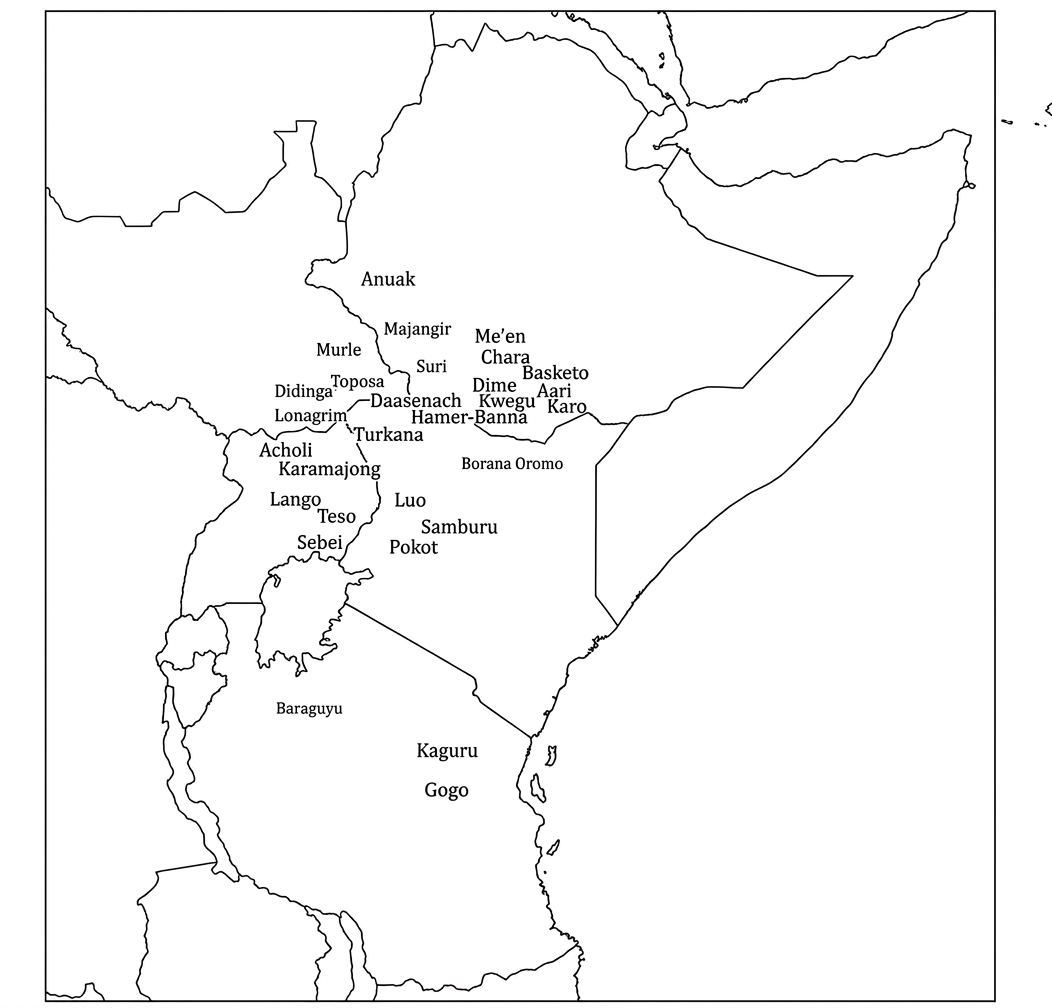
Peek referred to this type of divination as “East African sandal divination” (Peek 1991, 12). It is found in five contiguous countries of eastern Africa: South Sudan, Ethiopia, Uganda, Kenya, Tanzania. But it is very striking that it is also found among the Berg Dama/Bergdama of Namibia (Vedder 1928, 64).
So far, I have found sandal divination documented only in Africa, not in any other parts of the world. This makes the practice of sandal divination among the Bergdama in Namibia very interesting. Sandal divination is not documented anywhere near the Bergdama. This very strongly suggests that it was transmitted to the Bergdama from a group to the east, not the other way around.
2.4. Repeated throws
Most of the descriptions of sandal divination are very brief. Four of them specifically mention that the sandals can be tossed again, repeating the process.
-
Murle: Tossing sandals is “repeated several times, and the art is to be able to read the answer revealed by the pattern in which they fall” (Lewis 1972, 139).
-
Sebei: “Each throw was expected to be the answer to a specific query. … Sometimes … Kambuya did not seem to like the answer, and he picked the sandals up and threw them again” (Goldschmidt 1969, 27).
-
Gogo: “There is a possibility of repeating the ritual of finding the problem” (Chilala 1999, 14).
-
Lango: “An unlucky fall of the sandals is not necessarily conclusive, the inquirer persisting in the throws until a good omen is conclusive; but should the omens persistently remain bad after several throws the prediction is accepted” (Driberg 1923, 264).
2.5. Imported practitioners
- Describing divination by the Kaguru, Beidelman noted, “There are a number of renowned non-Kaguru diviners operating on the borders of Ukaguru” (Beidelman 1963b, 70).
2.6. Modern world and opposition to divination
I specifically looked for reports of opposition to sandal divination by organizations or people that represent ‘modern’ assumptions or Christianity. I e-mailed some authors asking about this, but none reported any examples.
Only one of the articles mentioned opposition to sandal-throwing divination. Sundal interviewed a Karamojong diviner outside of a hospital, “I don’t play my (divination) sandals there. I play the sandals outside the hospital because the staff doesn’t want my work there” (Sundal 2012, 583).
McMahon interviewed Didinga men from Sudan[5] who had moved to the USA, asking them about sandal divination. One explained, “‘Life is easy here’… [said James], who said that in the United States tooto [divination] was unnecessary” (McMahon 2007, 79).
McMahon asked, “So it can’t work in the United States?”
A Didinga man replied, “It can. So why do it in Sudan? Because everything is harsh” in Sudan (McMahon 2007, 80).
In the minds of these Didinga men in the USA, it appears they no longer need the guidance from the ritual practice of sandal divination.
This is similar to Malinowski’s insight about Trobriand fishermen facing danger.[6] “While in the open-sea fishing, full of danger and uncertainty, there is extensive magical ritual to secure safety” (Malinowski 1954, 31). But these fishermen knew they could fish successfully in the safe lagoon without dependence on magical ritual.
Similarly, these Didinga men feel that back in their homeland in (South) Sudan, “everything is harsh” (McMahon 2007, 80). But “Life is easy here” in the USA so they do not need to depend on divination.
2.7. Sex of diviners
Most of the descriptions of diviners did not mention anything specific about the sex of the diviners. Some of the descriptions of diviners specifically identify the diviners they observed as being male. Houtteman said that among the Daasenach, “Most of these diviners are male” (Houtteman 2014, 133). Driberg said that among the Lango, doing sandal divination “is not open to women” (Driberg 1923, 264). In contrast, Tippett noted that among the Majang, diviners are “usually female” (Tippett 1970, 173).
3. Conclusion
This paper has collected and presented documentation that sandal divination has been practiced all the way from South Sudan down through Tanzania, and surprisingly, also in Namibia. I have adopted Peek’s label, “sandal divination.” I have also shown several commonalities that are repeatedly found among various groups that have practiced sandal divination.
It is clear that sandal divination has been practiced more widely than previous scholars have noted. Most of the ethnic groups that are mentioned here are near the Nile or Omo Rivers. Also, it is found in Tanzania, which is not near the cluster just mentioned, but notable. But the report of sandal divination in Namibia is highly unexpected, over 1,800 kilometers from Tanzania.
This article has documented that sandal divination has been practiced in communities that are far from each other. This shows the need to investigate where sandal divination is found in between the groups already cited.
Acknowledgments
This paper would never have been begun without helpful conversations with Majang friends in western Ethiopia. It is my obligation and joy to thank my wife, Carole, for many kinds of encouragement and help, including interlibrary loan service. I also want to acknowledge friends and colleagues for advice and helpful emails, especially Jack Shoemaker and Rob McKee. I also acknowledge the usefulness of the website archive.org.
Additionally, some groups live on both sides of Ethiopia’s border with South Sudan and Kenya, usually cattle keepers with their herds.
Different sources use the alternate spellings ‘Karamajong’ and ‘Karimojong.’
Jok is the name for a high deity.
Ca. 10 x 7.5 cm.
The Didinga men left Sudan as refugees. They still spoke of ‘Sudan,’ though their former homeland is now in South Sudan.
I am grateful to Jack Shoemaker for telling me about Malinowski’s observations.