
1. Introduction
A Concerning Problem
In the effort to finish Bible translation in the remaining languages of the world that need it, it has become clear that addressing the non-use of local language (LL) translations cannot be ignored. For every translation that is finished but not used, two language communities are negatively affected—the one that did not use it or need it, and the one that did need it and could have been served by those same funds and resources.
This Vernacular Scripture Use (VSU) research program will consist of multiple studies. These studies will address the question of non-use of LL Scripture on a broad scale—assessing translations via evidence-based surveys in multiple countries and across multiple continents and looking at translations done via multiple methodologies and multiple agencies. In short, we want to: 1) have a better understanding of the extent of vernacular Scripture use and non-use worldwide, 2) have a better understanding of why cases of non-use occur. We begin this research program with this pilot study in Sulawesi.[1]
A considerable amount of VSU scholarship has been done in the past. Here is just a sample: Dye (1982; 2009), Landin (1990), Harris (1997), Hill (2000), Griffis (2011), van den Berg (2020), and Ndemba (2025). The most cited of these studies has been Dye’s (2009) paper that identified 8 conditions that influence the use of local language Scriptures. In his writing, Dye rightly points to two important concepts - ‘appropriate language’ and ‘socio-cultural situation’ - that we will be addressing in this paper, albeit via other terms.
Although these eight conditions are alike in that each one must be adequate for Scriptures to be used, the things that can be done to improve them differ considerably. Appropriate Language and Freedom to Commit are affected by the whole socio-cultural situation and are difficult to change. (Dye 2009, 1)
The “appropriate language” condition referred to above —the language a community perceives as most suitable for the function of printed Scripture—is a product of the local ‘language ecology’, or what Dye refers to as the “socio-cultural situation.” A language ecology is the social context of a region, including its languages, the communities that speak them, and the relationships among those languages and communities (Haugen 1972).
Ecological factors such as patterns of multilingualism/diglossia, community language repertoires, and relative prestige can be viewed as givens within a particular ecology. These factors change only when broader social forces alter the relationships among the languages and communities involved. Because these dynamics form the underlying reality within which all other conditions operate, we regard ecological factors as primary and all others as secondary.
There are two reasons for this. First, ecological factors are a priori conditions that exist before translation is considered. Second, they are generally the most resistant to change, whereas many other factors can be influenced through planning and intervention. For these reasons, we consider the “appropriate language” condition to be the most critical of Dye’s eight conditions. If a translation is not produced in a language that is appropriate to the local ecology, the significance of the remaining conditions is greatly diminished.
Diglossia: A Compelling Solution
One of the main reasons a language is perceived by its community of speakers as ‘appropriate’ for a given function is if it has the appropriate level of prestige for that function. The principle that motivates this perception is known in sociolinguistics as ‘diglossia’. Diglossia is the underlying reason for a community perceiving a national language as more appropriate for literacy and Scripture than their local language. As a general sociolinguistic principle introduced by Ferguson (1959), one of the pioneers of sociolinguistics, diglossia has become an accepted theory explaining much of language use in multilingual communities. Diglossia in a nutshell is nothing more than the linguistic division of labor. It refers to the phenomenon whereby multilingual communities divide up the social functions common in their every-day lives, assigning the national (and more prestigious) languages to the more formal functions and the local (and less prestigious) languages to the more informal functions. Ferguson (1959) introduced the idea of diglossia via his well-known study among majority languages and their related colloquial variants. Fishman (1967) built on Ferguson’s idea and extended it to include unrelated languages, or ‘broad’ diglossia. It is this later usage that we adopt here. Broad diglossia is a concept that helps us to understand how multilingual societies compartmentalize their language repertoire according to the social domains most appropriate for each language. Once a language becomes established as the norm in one type of domain, using it in the wrong domain is not accepted as appropriate by the community.[2]
For most sociolinguists, diglossia is seen as a given human behavior, applying to all communities. Even those societies that are monolingual will compartmentalize the dialects, registers and styles at their disposal in a diglossic manner depending on the function at hand. As Fasold reminds us “diglossia never ends; it is a human universal” (Fasold 1984, 57). As Scripture is commonly seen as a highly formal function for language, the influence of diglossia in an ecology would typically predict a preference for the use of NL Scriptures over LL Scriptures when both are available.[3]
Finally, diglossia is also part of the history of any minority language community as it moves from a pre-diglossic era before any significant contact with the national culture and language, to a diglossic era of increased contact, various levels of multilingualism and outside influence. The point at which LL translation occurs within that history will be an important part of this research program.
This understanding of diglossia as one of the greatest challenges to LL Scripture use is not unique to us. It has been discussed in Franks (n.d.) paper “Old habits die hard” (though he does not mention ‘diglossia’ per se) and is a concept taught in multiple Scripture Engagement (also known as Scripture Use and Impact) training courses throughout SIL (https://www.sil.org/training/scripture-use-and-impact).
However, to our knowledge no VSU research has yet been published that tests the effects of diglossia over time on current LL Scripture use. By investigating this question, we hope to determine whether this fundamental ecological factor clarifies which communities are most likely to adopt vernacular Scripture.[4]
Timing of Translation Hypothesis
To understand the effects of diglossia in the scripture use domain, we have developed what we call the ‘timing of translation’ hypothesis. Because this hypothesis applies to our entire research program, we felt it necessary to spell it out clearly in this first paper - and repeat it in every study, even if the results of this initial study are inconclusive in regard to the hypothesis itself. It is a hypothesis accompanied by a set of exceptions - not the statement of a given universal fact. We begin, however, with the history behind this idea.
The Precedent
The idea of the effects of ‘timing’ on language use is not new. To find a precedent in sociolinguistic literature, one can go back to the original writings on diglossia where we find that Fishman proposed a similar, yet lesser known, concept in his discussion of changes in media (orality vs literacy). This is pertinent when we realize that a change in the media used is also a change of both domain and formality and can thus effect a change in language choice. Fishman’s (1964; 1965) concept of ‘media variance’ (the choice of orality or literacy in either the local or national language) thus serves as a foundational precursor to our current proposal.
Media Variance: writing, reading and speaking. — Degree of mother tongue maintenance or displacement may be quite different in each of these very different medias. Where literacy has been attained prior to interaction with an “other tongue” reading and writing use of the mother tongue may resist displacement longer than speaking usage. Where literacy is attained subsequent to (or as a result of) such interaction the reverse more frequently obtains.
While speaking mainly of indigenous language maintenance, note that Fishman has already touched upon the issue of ‘timing’. Namely, where literacy in the indigenous language is acquired before interaction with an outside majority language, such literacy may resist displacement by L2 literacy. But where indigenous language literacy is introduced after the introduction of the national language, the persistence of such indigenous language literacy is less often the case. While Fishman did not provide data from case studies to support this claim, our current proposal builds on his widely accepted formulation of ‘broad diglossia’ plus his lesser known idea of ‘media variance’ and applies them to the area of scripture use in multilingual indigenous communities via evidence-based research.
The Hypothesis
We believe that the most fundamental reason for the non-use of LL scripture can be summed up by the following hypothesis. This is the hypothesis that we will be testing in this research program. This hypothesis takes diglossia and Fishman’s idea of timing and applies them to the scripture use of multilingual minority communities[5]. It can be formulated in the following way:
A) A local language (LL) translation does not become a Scripture of normative public use if a national/regional language (NL) translation has already become normative in that domain.[6]
Putting this in simpler language, a national language translation will be preferred over a LL translation if the NL was used first in the public scripture domain. More specifically, when the local community is multilingual and a NL Scripture is the first one to be regularly used in that society, this creates a diglossic scenario with the H or prestige language being used for formal purposes (scripture reading) and the LL being used for less formal functions. Later, when the translation of the LL Scripture arrives, the prior presence of diglossia in those scenarios will be a strong compelling force for the continued usage of the NL Scripture, and consequently, the non-use (or very little use) of the local scripture.
But the Timing of Translation hypothesis is also accompanied by its inverse.[7] The inverse implication of the hypothesis is that the LL scripture translation may be used in a normative way if it was the first language to be introduced in the public scripture domain, and, more importantly, it may continue to be used in that way after the arrival of NL scripture. It is in this second scenario where a window of opportunity exists for the use of LL Scriptures - when they are the first ones embraced by the local church, and thus are not initially competing with a national language in the same domain. Later on, usage may or may not shift to the NL Scripture when it is introduced. But it is this strong, pre-existing association of a LL to the Scripture domain in the pre-diglossic phase that gives it a fighting chance for continued use during the diglossic phase. We would propose that it is in this inverse scenario, in communities where the LL scripture came first, that the greatest chance for present day normative use of LL scripture exists. This corollary can be rephrased in a second formal statement:
B) LL scriptures with normative use in public worship today are those that were utilized in that same manner before NL scriptures were introduced.
Thus, the basic prediction of the timing of translation hypothesis is that if we want to see normative use of LL scriptures, the order in which LL and NL translations become available matters, and will generally have an effect on the overall usage of these translations. This would particularly be so for the LL.
However, it is critical to note that the hypothesis and its inverse corollary are not created equal. Due to power dynamics typically present within diglossic ecologies, both parts of the equation are heavily weighted on the side of majority languages. In other words, when the LL Scripture is used first, diglossia predicts that it is still more likely that it will eventually be replaced by the majority language scripture.
The Exceptions - or Ecologies of Resistance
Since ecologies can vary widely, we also predict that exceptions to the timing of translation hypothesis will exist in particular ecologies, limiting its influence.[8] We are referring to these as ‘ecologies of resistance’, as they describe communities that are in some way resistant to the force of diglossia. So far, the types of exceptions we have collected appear to be quite limited and thus definable. They are defined by ecological characteristics that allow for the possibility of resistance to diglossia and provide more space for the LL—including LL Scripture use. These exceptions are thus extensions of the overall hypothesis. Barring the presence of such ecologies of resistance, however, the expectation is that diglossia will exert its influence on Scripture use.[9]
The exceptions reported to us thus far can all be categorized into the following ‘ecologies of resistance’. These are the scenarios where we predict that it could be possible for LL Scripture to be used regularly after NL Scripture has been used:
-
Church policy – LL Scripture use is encouraged by wider denominational policies/norms, or established by mandates from a centralized church hierarchy (seen often in liturgical churches), or used in pastoral training.
-
LWC - The LL in question is itself an LWC (or a very large local language), one that functions as a language of solidarity and/or identity across a broad region or nation, or one that is accorded some level of prestige within the larger national/regional ecology.[10]
-
Limited multilingualism – Scripture currently used is an NL or regional language in which the LL community has limited multilingualism (less than half of the community is proficient in it). This could also include liturgical languages, classical languages, LWC’s that are rarely used by the community in daily life, or a national language in the midst of small-scale multilingualism.
-
Resistance/Separatism – LL Scripture is in a language associated with resistance/conflict /separatism, the language of a group that is in political or religious opposition or conflict with the larger national community. The local community strongly rejects or is intentionally separating itself from the broader national identity.
All the cases reported to us of vernacular Scripture use occurring after NL Scripture use appear to fall into one of the above scenarios. However, as we will show, the data thus far indicates these are all exceptions and not the norm (either they only apply in a few churches in a language community, or their use in church is not regular). Only one of these scenarios (church policy) has been attested to in our Sulawesi data, yet research into these exceptions is ongoing. Other ecologies of resistance may come to light as we extend this study beyond Sulawesi.[11]
II. Research Questions
This research entails a phased project with multiple individual studies in different ecologies and in various parts of the world. This pilot is the first of those studies. The overall project has two objectives. First, each individual study in the project will describe the extent of both vernacular Scripture use and national language Scripture use in local language communities in a specific country or region. Secondly, the project as a whole will address the timing of translation hypothesis as it pertains to a wide collection of data from different countries. Our research questions based on those objectives are both descriptive and analytical:
Research Question 1: The Descriptive Component
RQ1 - What is the extent of local language and nation language Scripture use in each country or region surveyed?
Research Questions 2 and 3: The Analytical Component
RQ2 - Do local language Scriptures become the/a normative text for public reading in public worship if they are introduced after national/regional language Scriptures have filled that role?
RQ3 - a) Were any local language Scriptures used in public worship before national language Scriptures were introduced? b) If so, are those local versions still in use?
In this study we will address each of these questions as applied to Sulawesi.[12]
Definition of Terms
A few definitions are in order:
Scripture – printed NT or whole Bible. In this study we are focusing primarily on printed Scripture. While we observed and noted the few times vernacular oral Scriptures were used during our survey, we are not making any claims about the use of oral Scripture, so it is possible that vernacular oral Scripture may not have these same limitations. However, we highly recommend that a similar study be conducted on the usage or non-usage of oral Scripture.
Normative text – by this we mean that it is the custom for a particular translation to be read publicly in a worship context. We are not looking for the occasional usage, but for usage that is the expected norm. If either the national or the indigenous language are new to the church domain they would not yet be considered normative (for this study, ‘new’ will be less than one year). If there is a mixing of both Scriptures being read out loud in church settings, we will report on the percentage of use of each. We will consider anything at 50% usage or more as normative use. If there seems to truly be a 50/50 mixing, both the national and the indigenous language would be considered normative.
Public reading in public worship – by this we mean that the Scripture is being read out loud by members of the local indigenous language community in places of group worship. This could be in the church setting, in home Bible studies, in prayer meetings, in outdoor religious celebrations, or any other place where members of the congregation gather to practice their faith in a public manner. By public reading we mean a practice by local church members and not outsiders (such as expat missionaries, national missionaries, or other members of a translation committee who may not be local). The tools we used did not focus on either private usage of Scripture or oral usage, such as listening to audio recordings of Scripture or the public singing of Scripture.
Why focus on Scripture in worship?
The most iconic and common domain of Scripture use is its public reading in church worship at least once a week. We believe that this has historically been the expected use of vernacular Scripture by the Bible translation movement across the globe. Certainly additional individual usage would be desirable and commendable, but that usage is always practiced by a minority or subset of those who attend worship. Thus, use in public worship appears to be the expected minimum for a translation, and researching that use would capture the moments when most people have access to scripture in a given society. A quote from Hill (2000) shows a common expectation that a successfully completed Bible translation would generally entail the reading of the vernacular Scriptures in public worship:
We can consider [the] Scripture use task finished successfully when…Church leaders use the existing translated Scriptures in situations where formerly they translated orally from a language of wider communication…If this goal is not met, we cannot say that we have succeeded in Scripture Use.
III. Scope and Methodology
Scope
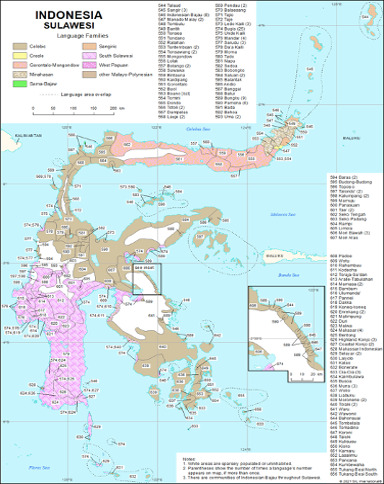
Sulawesi, Indonesia, was chosen as the area for this pilot study as it is a region where a considerable number of vernacular Scriptures are now available, and the majority was literate in a national language before indigenous literacy/translations arrived (Valkama 1987).
.png)
We targeted all of the minority languages of Sulawesi that fit the following parameters:
(1) the New Testament (or whole Bible) is available in the indigenous language
(2) the LL translation is at least one year old (to avoid the ‘celebration factor’)
(3) the community is not in a restricted area for travel.[13]
(4) the language is at EGIDS 6a or stronger (according to initial estimates)[14]
(5) there is a local church led by local leaders
After applying our above criteria to the language communities of Sulawesi we arrived originally at the following 19 languages: Toraja-Sa’dan [sda], Sangir [sxn], Talaud [tld], Tabulahan [atq], Mamasa [mqj], Bambam [ptu], Rampi [lje], Behoa [bep], Bada [bhz], Balantak [blz], Da’a [kzf], Napu [npy], Pamona [pmf], Uma [ppk], Sedoa [tvw], Mori [xmz], Tontemboan [tnt], Seko Padang [skx], and Manado Malay [xmm]. However, the data collected on the use of Manado Malay [xmm] scripture was not sufficient to draw any conclusions over such a broad population. Thus the dataset will only include 18 languages.
Methodology
Length of survey
Data collection within the 18 language communities was completed via 4 survey trips taken over a 22-month period, from July 2022 to February 2024. Total time spent in villages for this research: 5 ½ months.
Village selection and ‘Ground Zero’
Our strategy was to always begin our survey in the place of most likely use so as to capture any use that might be present. Author 1 attempted to spend most of his time and collect most of the data in ‘ground zero’, the village or cluster of villages where the translator had resided or worked. Usually, the translator and/or his family had lived in that village for several years and had promoted reading Scripture in the mother tongue. So, it stands to reason that the highest rates of use of mother tongue Bibles would be in that village. The idea was that the rates of mother tongue Scripture use in other villages would most likely be lower. This indeed turned out to be the case. The village where the translator resided was the one most likely to use the Bible he or she had translated. We will use this concept to help us to estimate usage across larger communities,
Tools
This survey was mostly quantitative. The unit of analysis was church use of the LL Scripture in worship, supplemented by group use in the home domain (although two of the tools gave some evidence of individual usage as well). Author 1 was the main researcher and conducted the survey in Indonesian. Much of the description of the tools below is based on a previous paper outlining our methodology (Anonby et al. 2024, https://leanpub.com/evidence-based-research)
Multiple tools were utilized to collect the data. This reflects the additional objective within our research project to provide data on scripture use via evidence-based methodologies that do not depend solely on self-report and observation. This set of tools allows for concrete evidence to support reported claims whenever possible via audio and photos.
For data on historical usage of Scripture:
- Historical research
For data on current usage of Scripture:
-
Observation
-
Interviews
-
Recordings of worship services
-
Scripture photography tool
We did not, however, use any SE strategies so as not to bias the data in any way by suggesting our own opinions as to which scriptures should be used. A short summary of each of our tools follows.[15]
Historical research
To gain insight into past usage of Scripture in these language communities, Author 1 visited local seminaries of the Reformed[16] churches of Sulawesi, the largest branch of Christianity in that area. Via resources found in these seminary libraries, as well as other resources online, various authors provided glimpses of past practices in these churches. Most of these were Dutch authors dating from 1918 to 2001. These sources were: Abineno (1979), Adriani (1919), Aragon (2000), van den End (2001), Kilgour (n.d.), Nooy-Palm (1975).
Observation
Author 1 spent multiple days in each language community, making sure that he was always there on a Sunday. By arriving several days before Sunday enabled him to lessen the observer’s paradox so that more natural use of language could be observed. He usually stayed in the homes of church leaders or local translators. He was present in and observed as many church worship meetings in as many denominations as possible during his stay. This included home meetings, which were often several. These observations usually included the language practices of the villages and numerous churches in each language group. Furthermore, it also included observations of oral Scripture use.
Interviews
A total of 100 interviews were conducted. Author 1 asked both laypeople and church leaders various questions related to language ecology. The most important question was, “How many Sundays was the LL Bible used last year?”
Questions that addressed language ecology conditions were highlighted in the questionnaire. Our focus was on the factors that are part of the pre-existing contexts of language ecologies (such as domains and diglossic usage), and how these contexts themselves influence Scripture choice. While Author 1 attempted to interview both church leaders and laypeople from each church visited, it was found that interviewing laypeople sometimes provided less biased responses than interviews with church leaders/translators, as the latter might feel their reputations or employment to be in jeopardy.
Recordings of worship services
Across the 18 language communities visited, almost 50 separate recordings and 100 hours of audio from both home and church services were collected from various denominations (liturgical and non-liturgical, Pentecostal and non-Pentecostal). These recordings are evidence of Scripture usage on that particular occasion. They were then annotated to identify which parts of the service were in LL and which were in Indonesian, and to allow anyone to locate the Scripture reading in the recording. This is shown by the following excerpt from the Napu language community:
-
17:58–19:20 Scripture reading in Napu
-
19:20–22:19 Baptism ceremony in Indonesian
Scripture Photography Tool
The purpose of this tool was to provide evidence of Scripture usage over time by individuals (either publicly or privately). For this tool, Author 1 took one picture of the outside of an LL Bible, and another of it opened to John 3:16. He tried to ensure the book in question was at least two years old to allow time for some wear. After doing this with the vernacular Bible, Author 1 would ask the owner to show his or her Indonesian Bible and repeat the procedure. He then assessed the condition of each of these Bibles based on the scale outlined below.
Photographs were taken of over 200 Bibles. They were then divided into three categories: (1) unused, (2) lightly used, (3) well used. For example photos of each of these categories, see the Appendix document.
Uses outside church domain
A secondary focus of this study was to look at any evidence of vernacular Scripture usage outside of the church. This included such contexts as small groups, home use, or individual usage. The Scripture Photography tool also provided some evidence of individual use. A Bible that is in pristine condition is most likely not being used either in public or private contexts.
Triangulation
The above methods were implemented in each community to corroborate/triangulate findings. The main tool used to assess Scripture use over time was the set of interviews from both church leaders and laypeople. But at times there were conflicting responses to the question of yearly use from different interviewees. If the church leaders claimed no LL Scripture usage, then triangulation was not critical. However, if the church leaders claimed usage (the more expected response) we would then look at the responses from the laypeople. If these responses were in conflict with those of their leaders, we would then refer to the recordings of the worship service, the presence or lack of LL Bibles in the community, and the condition of the LL Bibles compared to the NL Bibles (comparing wear and tear found in the Bible photos). This evidence-based approach allowed us to corroborate the findings and to provide evidence to help us determine which interview responses were most reliable. In many cases the lay people provided the responses that best matched the other observable data. Often, one final interview or conversation provided a story that would finally make sense of all the data.
Calculating Use
The numbers on LL Scripture usage in Table 1 are derived from asking questions of members of every church in ‘ground zero’ (the place where translators lived or the target location for the translation). These questions would ask about the frequency of LL and NL Scripture use in public worship over the span of last year. Table 1 compares the number of Sundays per year that the LL Scripture is used versus the Indonesian. This is an estimate based on respondents’ claims about usage in ground zero as well as the claims of local leaders about usage across the entire language area.
Our calculation for usage across a whole language community was arrived at via the following steps: 1). identifying the percentage of reformed to non-reformed churches found in that language community.[17] This was because scripture translation was done in partnership with reformed churches in most cases, and it would be among those churches where usage would be most expected. This would involve discussing this with local church leaders if the community was too large for direct observation 2) interviewing members from each of those types of churches to get the reported amount of LL scripture usage in each type in ground zero (triangulating those responses with observations, audio recordings and Bible photos as needed). 3) asking local leaders in ground zero to provide an estimated percentage of LL scripture usage across the rest of the community for each denomination. In cases where a local leaders assessment was not available, we took the percentage of usage of each type of church in ground zero as the assessment for usage of that type throughout the community as a whole. 5) applying the estimated percentage of usage within both reformed and non-reformed churches to the estimated percentage of churches from each type to arrive at a combined estimate of usage across the whole community. Because many of these estimates are an extrapolation of usage based on ground zero, the community results will most likely err on the generous side as usage would be expected to diminish as one gets further from the ground zero location. For example, around 50% of the Sangir churches were Reformed. Of these, members and leaders reported that their churches used the Sangir Scripture once a month. That would mean that among the Reformed churches we will estimate the LL Scripture use at 12 times a year. But if we include the estimated number of non-Reformed churches present in the community - that claim to almost never use the LL Scripture (averaging 1 time per year in ground zero) - the percentage of LL Scripture use throughout all the churches decreases to roughly eight Sundays per year.
IV. Findings
Language use in the Christian context
Use of the Vernacular Scriptures
When asked how often the local language Bible was used in church, by far the most common response was once a month. However, closer investigation revealed the answer was much more nuanced. For example, some Pentecostal congregations reported using the vernacular every few years, while others were not even aware there was a Bible in their language. There was also a great disparity between Reformed congregations. For example, in many communities there were only one or two churches which followed the Synod’s rules of having monthly services in the language. Case in point among the Mori, there was one Reformed church (out of 49) that had monthly services in the vernacular.
But even in the special services in the LL, most of the time the announcements are in Indonesian. It seems to take extra, advanced planning to conduct services in the vernacular. People usually have to spend hours practicing singing or reading Scripture. For example, when we were in Sangir, Easter Sunday fell on a designated local language day. But they told us that planning a holiday service in the language would be too difficult, so they used Indonesian.
The use of vernacular Scripture in church is rarely spontaneous. Instead, reading LL is something of a performance. For example, one of the activities in a youth rally was a Sangir Scripture reading competition. In another instance, a Tontemboan native language service was delayed half an hour late as the leaders practiced their lines in a neighboring room.
One clear indicator of the lack of use of the vernacular Bibles was that they were often locked up or otherwise very hard to find. In other places, such as among Manado Malay, many people weren’t aware of the existence of a Bible in their language. In Manado city, Author 1 visited a large Christian bookstore. Though there were many shelves of books translated into Indonesian from English, there were no Bibles in Manado Malay.
In the 1980s, Aragon (2000, 177) noted how the Uma expressed great pride in having Scripture in their language, yet in all her years of fieldwork, she never saw them use the book. Forty years later, Author 1 found many of the same attitudes and behaviors. Many knew details about how and when the Bible was translated. However, when Author 1 asked to photograph the Bible they were talking about, the book would frequently be unused, often still wrapped in plastic. Observations such as these gave us the impression that many thought of vernacular Bibles as precious artifacts, to be given to friends or carefully stored.
The situation was similar with non-print media. The Sangir, Napu, Uma, Manado Malay, Bambam, Mamasa, Bada, and others expressed great excitement about having their Bible in electronic form. However, non-print media seemed to be used even less than print. Only on two occasions did Author 1 witness someone reading the vernacular Bible on the phone in church. Most people hadn’t downloaded the app yet. Those who had sometimes took up to fifteen minutes to find a verse. All were able to find the Indonesian Bible on their phones more quickly. It was almost the same situation with the Jesus Film, which had been translated into several of the languages we surveyed. People were very enthused about the technology and were eager to talk about how enjoyable the dubbing process had been. But Author 1 only saw the movie watched once, by a Talaud man in his living room.
Reasons for using the vernacular
In most liturgical, Reformed churches, the use of the LL Scripture in church worship was mandated or encouraged by the Synod. It was a common denominational policy to use the LL Scripture once per month. The actual practice on the ground was usually much less than that. Also, when people read vernacular Scripture, it was usually followed up with reading the same verse in Indonesian.
A common rationale expressed by leaders and congregants was that the LL Bible would help with language preservation. Almost all groups said they were concerned that the vernacular was being lost and believed having the Bible in the LL would preserve the language or encourage young people to learn it. In this sense, the LL Bible was a symbol of group identity.
In some locations, Author 1 was told the reason they used the local language in services was because the congregation, particularly the older members, understood it better. However, most older people Author 1 interviewed claimed the custom of reading in the vernacular was less about being considerate to them, and more about following the Synod ruling. Almost all the people who claimed they understood the LL Bible better were translators.
Another reason for Bible translation was financial. On several occasions, Author 1 had people approach him and recommend a friend or family member for a paid position on the translation team. In other cases, he had people talk earnestly about the need for Author 1 to sponsor the translation of the Old Testament, and express desire to be employed in the process.
The villages that use the most LL in church were invariably the ones most closely associated with the translators. Some of these hotspots reported much higher use of the vernacular Bible than average. For example, on Salibabu Island and Melanguane village (ground zero for the Talaud), churches reported using the Talaud Bible twice a month, versus the average of once every three months.
Reasons for not using the vernacular
Though Author 1 never asked people why they did not use the LL Bible, they frequently volunteered various reasons. The most frequent was discomfort in reading LL in public. In the vernacular language services, Scripture is usually read in both languages. Author 1 noted people always read Indonesian more fluently than their LL. Another reason given was lack of access to the vernacular Bible. Sometimes, people claimed dialectical differences impeded their understanding of the LL. Finally, there was the matter of appropriateness. Some groups, like Manado Malay speakers, felt it wasn’t proper to read the Bible in what was seen as more of an informal lect.
It may be that the most significant reason is simply that their needs were met by the Indonesian Bible. In the majority of the areas, people told Author 1 they understood Indonesian better than the vernacular. Some used the Indonesian Bible to help them understand the LL. So, it seems likely that lack of comprehension is a motivation for not using the LL Scripture. However, even in the areas where the vernacular languages were very strong, the LL Bible was rarely used. In these cases, lack of LL use was not because the people didn’t understand it. A more plausible explanation is that they had gotten used to having Scripture read and explained to them in Indonesian and felt that the prestige language was the more appropriate language for scripture.
All of the above points to one conclusion - once a congregation becomes accustomed to reading the Bible in a NL (in this case, Indonesian), they very rarely switch to using Scripture in the LL.
Results on historical usage
The Toraja, Pamona, Sangir, Mori, Talaud, Tontemboan, Bada, Napu and Uma were first educated in their LL. This was because this group of tribes were evangelized early on, and the first missionaries believed it was very important to communicate in the local languages (Aragon 2000, 103; van den End 2001). In keeping with this policy, the Bible was translated into several Sulawesi languages in the nineteenth century, after attempts at using Malay translations failed (van den End 2001). By 1896 many tribespeople had learned how to read in their native languages (Adriani 1919, 96, 135, 168, 170, 173, 231).
After independence, the schooling system became more widespread, and only used the Malay language, which was re-christened Indonesian. Starting in the 1980s there was an effort, primarily spearheaded by SIL, to begin translating New Testaments into the indigenous languages of Sulawesi (Aragon 2000, 310). In the 1970s and 1980s, SIL linguists allocated in several villages began translating the Bible into the various indigenous languages (Aragon 2000, 310). But by that time, Malay had been the only language of literacy for one or two generations.
By the early 2000s, a large number of vernacular translations had been completed and by the mid 2010s, many Reformed synods had begun urging their churches to use these newly translated Scriptures. Today, the upper leadership encourages monthly readings in the indigenous language. But while there is evidence of many churches that have switched from their native language to Indonesian, there are no examples of congregations who have switched back to using their native language as the normative text for public reading. LL Scripture reading almost exclusively occurs in special cultural services mandated by the church hierarchy, and these are held quite sporadically.
Results on current usage
All the tools, particularly the interviews and the photos, showed low levels of LL Scripture usage across these 18 Sulawesi languages. Since midweek use was much less than Sunday use, the metric we utilized was the number of Sundays per year that a given language was used for reading Scripture in public worship. When averaged all together, we found an average of 4 Sundays per year (or 8% of yearly Sundays) of LL scripture usage across all churches among the 18 languages we studied in Sulawesi.
Table 1 shows our results on vernacular Scripture use from two perspectives – from ‘ground zero’ and from across entire communities. The unit of measurement is the number of Sundays per year. The first column shows use in ‘ground zero’, where the translators lived or worked. This usage was assessed by way of interviews of church laity and leaders from ‘ground zero’ churches, supplemented by audio recordings of services and photos of member’s Bibles. Because it focuses on the places of most likely use, its average rate of use is higher. The second column, the broader use across whole communities is an extrapolated figure, based on the percentage of denominations either observed in ground zero or reported by local leaders, plus the estimate of usage local leaders provided for each.[18] Basing communal scripture usage partly on ‘ground zero’ usage is an intentional strategy to ensure that our methodology is not skewed towards the underreporting of vernacular scriptures. With ground zero being where use is most likely to be found, actual use in the rest of the community is most likely to either be the same or less. National language use (not shown in the table) was reported as weekly in all churches in all communities, indicating that when the LL is used, the NL is also used.
We found that in Sulawesi reformed churches use more vernacular Scripture than their non-reformed counterparts. The following data do not coincide exactly with the table above because some communities had a different percentage of liturgical (reformed) and non-liturgical (non-reformed) churches. For the strong languages (EGIDS 6a–3), the LL Scripture use in liturgical churches averaged roughly 5 Sundays per year (or 9.6% of yearly Sundays), while non-liturgical churches used LL Scripture less than 1 Sunday per year. Among the weak languages (EGIDS 6b-7), the liturgical churches also averaged LL Scripture usage at roughly 5 Sundays per year, while the non-liturgical churches did not use it at all.
The results of the Scripture photography tool helped to show more concrete evidence of the general trend of scripture use. Of the 200 some Bible photographed, there were 8 well-used LL Bibles and 61 well-used NL Bibles. Of these, the breakdown of well-used Bibles was as follows:
These results indicate that across the 18 language communities, LL Scriptures consistently showed less signs of usage than their NL counterparts. The vast majority of the LL Scriptures were in pristine condition, with no signs of wear. The NL scriptures, on the other hand, were used as the default scriptures for every church. Even on those Sundays when the LL scripture was used for the occasional cultural service, the NL scripture would also be used at some point. This means that the joint usage of LL and NL scriptures is the only way LL scripture use occurred in the churches in our sample.
Home Use
Author 1 attended many home meetings in Christian communities in Sulawesi, participating both in celebrations and Bible studies. In most home meetings everyone came with only an Indonesian Bible. Author 1 found LL Scripture reading to be very rare and often done for his benefit (or so they told him.). Also, when they didn’t tell him specifically, their eyes were often on Author 1 as the vernacular Scripture was being read. One reason the LL may be used in the home is if there is an ongoing translation project and the meetings are hosted by the translator. In fact, the only occasion where Author 1 observed an actual group of people studying or reading from the vernacular Scriptures together was in a Bible study at the Bambam translator’s home. In almost all the home meetings Author 1 attended, the entire service was in Indonesian. In fact, there was a lower proportion of LL Scripture use in homes than in Sunday morning church services.
This suggests that in Sulawesi, not only are the LL Scriptures not being used in a normative way in the churches (aside from a token cultural identity marker), they are also rarely being used in the home. This contradicts much of the current assumptions about LL usage (Russell 1936). It has always been the case that most Christians around the world get the majority of their exposure to Scripture from the public reading of the Bible in church settings. If this is true of highly literate societies, we should not expect it to be any different among the less literate ones.
V. Analysis
Addressing research question 1
Interview data, observation, audio recordings of services, and the comparison of the photos of LL/NL Scriptures all confirmed the current use of the LL Scripture is minimal across the predominately Christian groups in Sulawesi. Observations of informal home meetings in the villages found that usage in the homes was even less than in formal services. The four groups with the highest usage are the Napu, Behoa, Sangir and Bambam.[19]
Here is a summary of the major findings related to the state of Scripture use in Sulawesi:
-
The combined average of LL Scripture reading in all churches was 4 Sundays per year.[20]
-
The use that does happen occurs in liturgical denominations that mandate or encourage it.
-
Most Reformed congregations use the LL Scripture less than their synod recommends.
-
The average LL Bible was unused, while the average Indonesian Bible was well used.
-
There was more LL usage in church meetings than in home meetings
-
The default scripture for every church was the NL. Even on those Sundays when the LL scripture was used, the NL scripture would also be used at some point. This means that joint usage of LL and NL scriptures is the only way LL scripture use occurred in the churches in our sample.
There were numerous factors that did not appear to have any effect on Scripture use:
-
There was no difference in usage between languages with strong and weak vitality.
-
There was no significant difference in usage between old and new translations. Fifteen of the languages had New Testaments translations completed in the 2010s. The usage of LL Scripture among these fifteen was just as minimal as that found among those who received vernacular New Testaments in the mid 1900s.
-
There was little difference in usage between groups who had Scripture engagement and those who did not. For example, the Tontenbaum, Da’a, Tabulahan, and Toraja all have had people working in Scripture engagement. However, these efforts have not resulted in a higher rate of LL scripture usage.
The one factor that did make a difference was whether or not the congregation belonged to a Reformed denomination. Most of these had some LL Scripture usage (averaging 5 Sundays per year or 9.6% of yearly Sundays), while the other denominations used LL Bible less than 1% of the time. Usage of LL Scriptures in Reformed churches is clearly motivated by church policy, a practice that could be facilitated by the fact that these denominations are hierarchical while non-Reformed ones are much less so. Reformed churches also use more liturgy, a domain that might be seen as more acceptable for LL scripture than a printed Bible. In any case, LL scripture in the Reformed churches appears to have more of an identity function than a spiritual one. This last insight was based on the fact that in many Sunday worship services where LL Scripture usage was witnessed, this usage was accompanied by numerous other cultural markings such as traditional dress and more LL music. These cultural trappings were much less common during ‘regular’ worship services. This leads us to believe that most vernacular Scripture usage in Sulawesi is motivated more by an identity function than a spiritual one. (See the Conclusion for more on this insight.)
Addressing research questions 2 and 3
The answer to RQ2 from our Sulawesi data is clearly negative. In the communities studied, none of the vernacular Scriptures have become the normative Scripture in public worship settings after NL Scriptures filled that role.
In response to RQ3a, we found plenty of evidence in Sulawesi of LL Scriptures that were used before NL scriptures. 9 of the 18 communities had LL Scripture portions translated early on, before the spread of Indonesian literacy that followed the national independence in 1945. These were the Bada, Toraja, Pamona, Sangir, Napu, Uma, Mori, Tontemboan, and Talaud groups. While a non-standard form of Malay was used as an LWC in coastal areas as early as the 17th century, multilingualism and literacy in Malay did not become widespread in the highlands of Sulawesi until after 1945. Comments made by the authors listed in the sources below suggest that these vernacular portions were most likely being used until they were replaced with the more prestigious Indonesian Scriptures that came after independence.
Further evidence of early LL Scripture usage in some of these groups comes from our observations and photographs of early gravestones with indigenous language texts on them. Photographic evidence of early LL text on gravestones (much of it in the form of LL Scripture) predating the expansion of Indonesian was found in the following language communities: Sangir, Toraja, Pamona, Mori, Bada (see our photo database).
RQ3b asks whether we found any of the above scriptures still in use. Today, all nine of these ‘LL first’ churches are using the NL as their normative Scripture, showing that in each case the LL scripture was eventually replaced by Indonesian. Nevertheless, there was a considerable period when their LL Scriptures were the only Scriptures used, some of them for over a century. This would suggest that the lack of multilingualism and diglossia was indeed a factor influencing the usage of LL Scripture in the past. This pre-diglossic period might prove to have been the greatest window of opportunity for vernacular Scripture use in Sulawesi.[21]
While the first statement (Part A) of the timing of translation hypothesis has been shown to hold in Sulawesi, its inverse corollary (Part B) remains inconclusive - it cannot yet be proven true or false from our Sulawesi data alone. What is missing in our Sulawesi data are examples where the LL Scripture arrived first and where it continues to enjoy normative use today even after the introduction of the NL Scripture. This type of data would be needed to support the full hypothesis and to show that the timing of translation matters today. Our investigation of this hypothesis will continue to be developed in future studies, and the combined results addressed in a concluding paper. Some of our preliminary data suggests that by repeating this research in other ecologies (particularly those with different histories) we will find results with the potential of speaking to this question. Only at that point will we be able to conclude whether the ‘timing of translation’ hypothesis holds or does not hold, and if it holds, to what degree and under what conditions.
Exceptions in Sulawesi
Our findings also indicate that one of the exceptions to the timing of translation predicted at the outset of this study does exist in Sulawesi. This ecology of resistance is found among the liturgical churches that use LL Scripture in a limited fashion in spite of diglossic pressure. In four of these communities (Napu, Behoa, Sangir, and Bambam), the liturgical churches reported usage of LL Scriptures roughly once per month (alongside readings in Indonesian). Overall, liturgical church members report an average of approximately 5 Sundays (or 9.6%) of LL Scripture usage in public worship over an entire year (see Table 2). In each case this usage was reported by church leaders as something either mandated or at least encouraged by church policy. This is a confirmation of the existence of exception #1: “church policy”, even though the usage in question was quite low in most cases and never normative.
VI. Conclusion
Impact on BT past and future
This study has both past and future implications for the task of Bible translation. Our evidence shows that, on Sulawesi, none of the LL Scriptures studied have become the normative text in worship. Part A of our timing of translation hypothesis holds. If it continues to hold after applying it in other countries, it has the potential to provide an underlying explanation for why many completed Bible translation programs have never seen widespread indigenous Scripture usage in church.
Improving our understanding of the link between diglossia and translation will also potentially help BT agencies plan for the future. Once we have been able to apply this research in a broader number of countries and languages, we will be able to suggest a set of recommendations for future translation starts. But for now our Sulawesi data suggests reconsidering new translations in situations where there is already an existing church using a national language translation. Such scenarios show extremely low levels of vernacular Scripture usage in Sulawesi, while the inverse cases (LL scripture arriving before NL scripture) enjoyed a window of use for a significant time. If this pattern continues elsewhere, this new understanding could become useful for those assessing the viability of new translation projects and needing more effective ways to allocate resources. We will continue to report on the impact of the timing of translation as our research grows, and as our data set becomes more robust, covering more types of ecologies.
A Final Word: Some thoughts on human flourishing
We would like to close reflecting on the idea of human flourishing, and how these findings speak to that topic. In recent years, human flourishing/thriving has been adopted as one of the main objectives within the Bible translation movement. This is based on a recognition that the Bible, in any appropriate language, contributes to all of life and has wide benefits. Also, peoples with access to Scriptures are more likely to adopt the Christian faith. Such access to scripture may come in either the LL or the NL.
The above survey adds to this discussion by suggesting that it is possible for multilingual minority language communities to not only come to Christian faith via a NL Scripture, but to show signs of growth in faith via those same scriptures. While measuring the impact of scripture was not our objective, we observed that most of the Sulawesi churches studied are large, well-attended, with active youth groups, supporting their own pastors, and reaching out to their communities. In these ways they surpassed the original metrics established by Venn and Anderson (Warren 1971) of what constitutes an indigenous church — self-propagating, self-governing, and self-supporting. And in every Sulawesi church studied, the Scripture most associated with their journey of Christian faith was the NL.
In Sulawesi, the use of the NL scripture is not found in isolated cases but rather has become the most common means by which indigenous churches practice discipleship and experience growth. Taking the idea of flourishing seriously requires us to acknowledge that indigenous communities flourishing in the NL is not just a possibility, but it could be prevalent in many regions of the world. It also brings with it a growing awareness that the goal of ending worldwide Bible poverty may be closer to being realized than previously thought.
Abbreviations: LL = local language, NL = national/regional language, BT = Bible translation, VSU = vernacular Scripture use
The concept of ‘diglossia’ has since been addressed by many writers. Fasold (1984) introduced polyglossia, a term incorporating double-overlapping diglossia, double nested diglossia, and linear diglossia (which we do not have space to go into here), but the essence of diglossia remained the same (see Hudson 2002). Most writers focused on descriptive studies without changing any of the original theoretical underpinnings of the concept (Comrie 1991; Coulmas 1991; Trangoudaki 1992; Kaye 1994; Paolillo 1997). Diglossia later became Fishman’s main recommendation for the relatively new task of RLS, or reversing language shift (Fishman 1991; 2001). While many revitalizationists adopted this as their goal, this focus is not shared by all RLSers, such as Eckert (1980) or Romaine (2006), who are not comfortable with the power inequality inherent in references to H and L languages. Diglossia is also utilized in the language acquisition field (Palmer 2007), where its practical applications are still appreciated. Beyond these applications, however, sociolinguistic writings since the postmodern turn tend to reframe diglossia (often renaming it via a multitude of prefixes), preferring to portray it as a less rigid phenomenon, and shifting from the original focus on generalized types of language variation+association found at the communal level to the more fluid and nuanced variation found at the individual level (Jaspers 2017). While the details of individual variation are certainly worthy of study, we hold that studying language use at the communal level is still vitally needed, as this usage is what establishes social norms, which in turn influences individual use. If we want to understand widespread usage/non-usage of any linguistic resource, it is only at the communal level that our answers will have any practical relevance. Thus, we feel that the term ‘diglossia’, while now a bit out of vogue for many, is still a crucial concept for understanding the literacy choices of many minority language communities in multilingual language ecologies.
Language vitality is another factor that sociolinguists would consider an important and even obligatory support for the use of vernacular literacy. Language shift clearly undermines any attempts at LL literacy, a principle that has been encoded in the EGIDS scale (Lewis and Simons 2010), where there is a hierarchical relationship between sustainable literacy and sustainable orality, with the former being built upon the latter. However, we discovered that there are communities who do use their vernacular Scripture (to a minimal degree) even though their local language is undergoing early stages of shift (typically with the intention of using LL scripture as a tool to recover language loss). This type of usage also needs to be assessed. Furthermore, in this study strong languages and weak languages performed the same in terms of LL scripture usage.
Our VSU research methodology focuses only on assessment, intentionally avoiding Scripture engagement activities or any communication or action that might suggest any language preferences of those doing the research.
This does not however apply where there is small-scale multilingualism - ecologies where there is multilingualism between various minority languages, but without the inclusion of a majority language. In such cases diglossia would not be present and our hypothesis would not apply.
This tendency is stated in definitive terms because hypothesis statements must be falsifiable. It does not mean that we feel that the opposite is impossible or does not occur. It only means that we have come up with a clear statement that can now be falsified if data to the contrary was discovered. We do recognize that exceptions to this hypothesis exist and will discuss the ones we already are aware of in the next section.
The reader will discover that in this study of scripture use in Sulawesi, the inverse implication of our hypothesis is not present in the data. In other words, we did not find any LL translations completed before the introduction of the NL translation that are in continual use today. This would normally cast doubt on the validity or relevance of the hypothesis itself for the content of this study. However, our timing of translation hypothesis is not meant for this initial study alone but is offered as a hypothesis to be applied to a whole research program with numerous studies across multiple countries. This is just the beginning. There will be studies where it is not found to be present or to matter. We also have preliminary evidence to suggest that in other studies in other countries it will matter very much. Asking the same questions in all of them will be important later on as we eventually compare them and learn where this hypothesis applies and where it doesn’t. That in itself is important data. For that reason, we are spelling out the hypothesis and its inverse here at the outset of the entire research program, even though the inverse will not be evident in this particular study.
It is not uncommon for hypotheses to have exceptions. These are often referred to as limitations, or scope, or boundaries, spelling out ahead of time where the hypothesis is expected not to apply. In the case of the Timing of Translation hypothesis, we prefer the term ‘exceptions’ as we are referring to specific scenarios where diglossia is still present in the society but its influence in the particular domain of scripture use is expected to weaken. For there to be no evidence at all of diglossia in a particular multilingual community (except perhaps for small scale multilingualism contexts) is highly unlikely.
There is one final scenario that does not violate the timing of translation hypothesis - but it also does not involve an NL. That is when the prior translation used was not in an NL or prestige language. Instead, the first translation available was in a ‘church language’ or the language of a neighboring minority group. In such cases our hypothesis makes no predictions about the possible use of the LL translation.
Because Statement A of the timing hypothesis concerns the relationship between local-language translations and already-established NL translations, it does not apply to a translation in an LWC that is not itself a local language. The prime example of this would be creoles, speech varieties that started as trade languages or LWC’s from their origins. Consequently, the hypothesis makes no prediction about the normative use of scriptures in such languages.
Beyond these broader ecological factors, there may also be situations of LL scripture use that are influenced from the outside. These could be cases where specific individuals or agencies who were part of the translation team/process continue to influence the practices of local churches such that it is questionable whether the local church is making its own decisions about Scripture use. Evidence for this might be when the only church using the LL scripture is the one where the translation team member attends. Similar influence can occur if VSU assessments are made while outsiders are conducting ongoing Scripture engagement activities in local churches. Such cases are not included in our research as they are not clear examples of community choices.
Due to the lack of finding pre-diglossic scripture translations in Sulawesi that are still experiencing normative use today, we will have to await the application of this research in future studies in other parts of the world where more variation can be found across differing ecologies to determine if part B of the timing hypothesis can be shown to hold.
Author 1 was restricted from surveying language communities in which the majority religion is Islam.
Although the vitality criteria initially informed our sampling, during the course of the surveys we found multiple cases where the EGIDS level on the ground was lower than originally thought. These ended up being at either an EGIDS 6b (Balantak [blz], Behoa [bep], Napu [npy], Rampi [lje], Sedoa [tvw], Seko Padang [skx], Uma [ppk]) or an EGIDS 7 (Mori [xmz], Pamona [pmf], Sangir [sxn], Talaud [tld], Tontemboan [tnt], Toraja [sda]). Surprisingly, in each of these communities we still found some evidence of LL scripture use, albeit non-normative use (such as once a month or less). Since our goal is to capture and assess all possible cases of vernacular Scripture use, we will continue to include these languages in our study even though we later discovered they violated one of our initial criteria.
Links to the datasets of results from these tools (with interview responses, audio recordings, and Bible photos) can be found in the Appendix.
In this paper, the use of the term Reformed church(es) will be referring to any one or all of the Calvinist denominations with their synods in Central Sulawesi Province:
- Gereja Protestan Indonesia Donggala (GPID)
- Gereja Kristen Sulawesi Tengah (GKST) (GKST is the biggest synod in Central Sulawesi)
- Gereja Protestan Indonesia Buol Tolitoli (GPIBT)
- Gereja Kristen Luwuk Banggai (GKLB)
- Gereja Protestan Indonesia Banggai Kepulauan (GPIBK)
This reformed/non-reformed distinction is salient to most Sulawesi Christian communities, as it is reflected in their church history. The Dutch Reformed church was the first to establish itself in Sulawesi in the 1800’s, and then various Reformed denominations developed from that to become the dominant form of Christianity in the region. There are some exceptions, such as the Rampi, where the Pentecostal churches are now more prevalent than the Reformed churches, and the Uma, where the current distinctions that are most relevant are between the Salvation Army church (by far the most prevalent in this group) and the Pentecostals (a minority).
Links to the data behind these results, including the basis for estimates of communal use, can be found in Appendix A.
Two factors that may be influencing a slightly higher use of the LL among these 4 groups: 1) An influential leader that embraces the LL translation — (e.g. Sangir) 2) Members of translation committee still translating and influencing usage of LL — (e.g. Bambam).
This data comes from northern and central Sulawesi where the predominant liturgical congregations are those of the Reformed denominations. Via observation and interviews, Author 1 found that the Catholic congregations in this region did not use the LL Scripture. In Southeast Sulawesi, however, René van den Berg (p.c.) reports 50% usage of the Muna Scripture in a Catholic parish consisting of 7 congregations.
This parallels to some degree what we have seen in Brazil. According to personal observations and discussions with the translators involved, all of the Brazilian LL Scriptures that are being used widely in their churches today were the first Scriptures ever used by these communities. These are the older translations such as the Guajajara, Kayapó, Waiwai, Sataré-Mawé, Apalai and Xavante, all of them done before Portuguese schools and churches became widespread in those indigenous areas. The first portions of Scripture ever seen in these communities were in the LL. The difference between these Brazilian cases and the nine Sulawesi communities above is that these six groups in Brazil are characterized by strong group identities that have been resilient enough to resist change and continue normative use of their LL Scriptures even after the NL Scriptures arrived.