
1. Introduction
Over the last 300 years, Enlightenment Biblical scholarship has applied source-criticism, form-criticism, and redaction criticism with a Cartesian impulse. The authorship and provenance of everything from narrative to poetry and prophetic materials have been doubted, divided, and dissected into a patchwork of verses and phrases of various origins and historical periods resulting in serious doubt regarding the viability of the discourse-level analysis of texts. In response to this micro-division of the text, canonical and literary approaches instead began to focus upon reading the final form, while still accepting the various results of critical scholarship for determining canonical texture. On the one hand, canon critics investigate the gradual, historical accretion and editing of texts, while acknowledging the final form as authoritative for the church. On the other hand, literary analysts tend to perform structuralist reading and interpretation on the final form of the autonomous text as a work without recourse to the text’s historical genesis. Then in terms of postmodern, poststructuralist, and performance readings, very little constrains each reader or reading community as they construct their own meaning. When adding a consideration of pragmatics to this mix, the myriad historical views leave one with little hope of consensus.
Therefore, how may one move forward from this seeming impasse? Within the current context, one may legitimately perform a macrostructural analysis of the biblical text following in the wake of canonical and structuralist final-form readings. However, due to the historical component and the myriad critical views by which the text passed through the hands of multiple hypothetical tradents, the move from the text as a structured work to text-pragmatics proves problematic. Therefore, the following discussion will follow the approach of T. Desmond Alexander (2017, 11–16) by distinguishing between a source approach and a discourse approach, thus focusing on the meaning of the extant text rather than hypothetical earlier versions. Moreover, the following reading will attempt to understand the structural features of Ezekiel emically rather than introducing concerns not arising from the text itself. This implies an acceptance of the text’s own historical presentation and historical validity as described by Block (1997). Assuming this discourse and historical approach for pragmatic considerations, the book of Ezekiel dates to the period of the exile in Babylon and was either composed by the prophet himself or may have been compiled and arranged by a follower after the pattern of Jeremiah and Baruch (Jer 36:1–8).
Therefore, in the quest for describing and applying a sound interpretive methodology in the macroanalysis of the book of Ezekiel, discussion now turns to key considerations from Teun van Dijk’s definition of “macrostructure,” Walter Kintsch’s Construct-Integration model of cognitive text processing, Relevance Theory, and meaning construction in oral-derived literature. Moreover, relevant tools will be chosen from the field of discourse analysis that are appropriate for identifying key features in Ezekiel’s literary superstructure. In particular, considering Ezekiel’s anthological nature, the notion of inferred macropropositions from van Dijk and Relevance Theory will prove helpful for moving to the macrolevel across the boundaries of discrete oracles. The concept of macropositional implicature goes far in providing an interpretive tool for handling the juxtaposition of oracles, inferred thematic cohesion, and grouping by date. Although macroanalysis proves to be a neutral theoretical tool, this conservative evangelical application differs from canonical and structuralist approaches precisely in the pragmatic placement of the text on the historical plane with an exilic communicative situation in which the Lord speaking to and through Ezekiel is taken at face value (Block 1997). Both form and canonical-structuralist approaches provide tools for identifying the commonalities and rhetorical peculiarities comprising the oral-derived Scripture of ancient Israel. Moreover, reading Ezekiel as an oral-derived text provides a possible means for moving beyond methods and approaches that anachronistically foist contemporary reading concerns and understandings upon this historically and culturally distant work.
2. Theoretical Considerations for Macroanalysis
Before proceeding to an analysis of the book of Ezekiel, discussion will begin by briefly outlining the macroanalytic concepts that will be used. Teun van Dijk’s definition of macrostructure, Walter Kintsch’s approach to cognitive text processing, Sperber and Wilson’s inferential view of language, and William Miles Foley’s thoughts on oral-derived literature will shape the framework for articulating the cognitive formation of macropropositions from literary superstructure within an oral-traditional culture.[1]
2.1. Teun van Dijk and Macrostructure
To begin, what is macrostructure? Teun van Dijk (1980) observes that macrostructure remains distinct from microstructure, which refers to the local level linguistic features of a text (words, phrases, clauses, sentences, and connections between sentences). In contrast, macrostructures are higher-level semantic or conceptual structures organizing local microstructures in order to facilitate cognitive processing. Macrostructure organizes the elements, parts, sections, and units into a whole. Thus, macrostructures possess a cognitive basis since they are formed, executed, interpreted, and stored in memory. Gestalt theory forms the background of a cognitive account of macrostructure, with notions such as global and whole emerging from the background of perceived details.
Second, van Dijk distinguishes the surface literary style of a text from the abstract, semantic representation of the macrostructure (see below). He identifies the natural language use and literary style of a discourse as the superstructure, whereas global meaning structures may be abstracted from the superstructure. Genre conventions, which are conventionalized schematic and semantic representations, organize the meaning components and relations as part of the macrostructure of a discourse. Thus, for a narrative or the argument structure of a lecture one may identify the introduction, setting, background, development, and conclusion. Schematic conventions enable the activation of intuitive understandings of global organization, purpose, function, and meaning. Thus, conventional knowledge of schemata, scripts, frames, or scenarios organize textual propositions toward macrostructural organization, and superstructure genre categories define the functional relations between propositions and macropropositions in a text. Moreover, structural features at the syntactic level may contribute to global structure. Macrorules account for the summarizing and generalizing move from local-level processing up to the macro-level. For the Psalms and Prophets, considering the schemas and scripts identified by Form Criticism for literary superstructure prove important for analyzing the propositional macrostructure of a text.
Third, everything from the microstructure up to the macrostructure may be expressed as propositions. Although elements of logical notation may be used occasionally, van Dijk does not use the predicate calculus notation of formal logic. Rather, a simple and unskewed sentence form states the abstract meaning of the discourse sequence.[2] A macroproposition describes a text sequence of sentences with a propositional common denominator, and excludes irrelevant details not necessary for interpreting the passage as a whole. Furthermore, one is able intuitively to construct a proposition at a higher level of abstraction subsuming the underlying events. Macropropositions may be organized and assigned functional relations, such as A explaining B, and these relations may be indicated overtly by discourse markers or inferred. Various relations include explanation, explication, specification, preparation/presupposition/precondition, contrast, confirmation, illustration, comparison, and premise/conclusion (Grimes 1975; van Dijk 1980, 88; Beekman et al. 2018).
Fourth, the knowledge context is an important cognitive factor (van Dijk 2008; 2009). Both speakers and hearers assume knowledge of the communicative situation that may not be stated explicitly in the discourse. A cognitive model specifies these missing links. Moreover, different language users will develop different macrostructures since this process depends on the monitoring schema, which predetermines what will be seen as the relevant information of the text. In addition to our knowledge, macrostructure formation is dependent upon the contextual factors of our beliefs, attitudes, tasks, interests, values, and norms, otherwise known as the cognitive set of the language user. Thus, a concept or proposition that is structurally unimportant may become prominent or salient due to a language user’s personal memories, associations, values, attitudes, or interests. Salience (relevance) differs with cognitive set, and so different readers will find different elements of the text relevant in processing and recall.
In turning to the macroanalysis of Ezekiel, as well as other biblical materials, these considerations suggest the need to identify typical structural forms characteristic of the prophets, as well as rhetorically significant departures from those forms.[3] For the first step, the juxtaposition of oracles with a common theme justifies positing a summary proposition common to each of the oracles within a given unit. Next, the identification of prominent and marked structural features in the literary superstructure will raise the prominence of an associated macroproposition within the propositional hierarchy and possibly augment it. Therefore, the ideal reader will want to be on the lookout for various types of rhetorical devices influencing macroproposition formation.
2.2. Walter Kintsch’s Construct-Integration Model of Cognitive Text Processing
van Dijk and Kintsch (1983) put forth a theory of text-comprehension from which Kintsch (1998) developed the Construct-Integration (CI) model of text processing. This approach seeks to describe how the mind processes a text in order to work from the lowest levels of the linguistic hierarchy up to conceptualization of an entire discourse or text—a situation model in Kintsch’s terminology.[4] Kintsch’s theory is a psychological process model accounting for the perceptions, concepts, ideas, images, and emotions involved in the comprehension process, and it is not limited to an analysis of the materials to be comprehended. Moreover, from initial cognitive chaos, the CI model assumes an ideal reader forms a mental representation of the text essentially complete and correct. Both the texts and knowledge involved in this process are represented as propositions or semantic vectors in relatively unstructured associative networks.
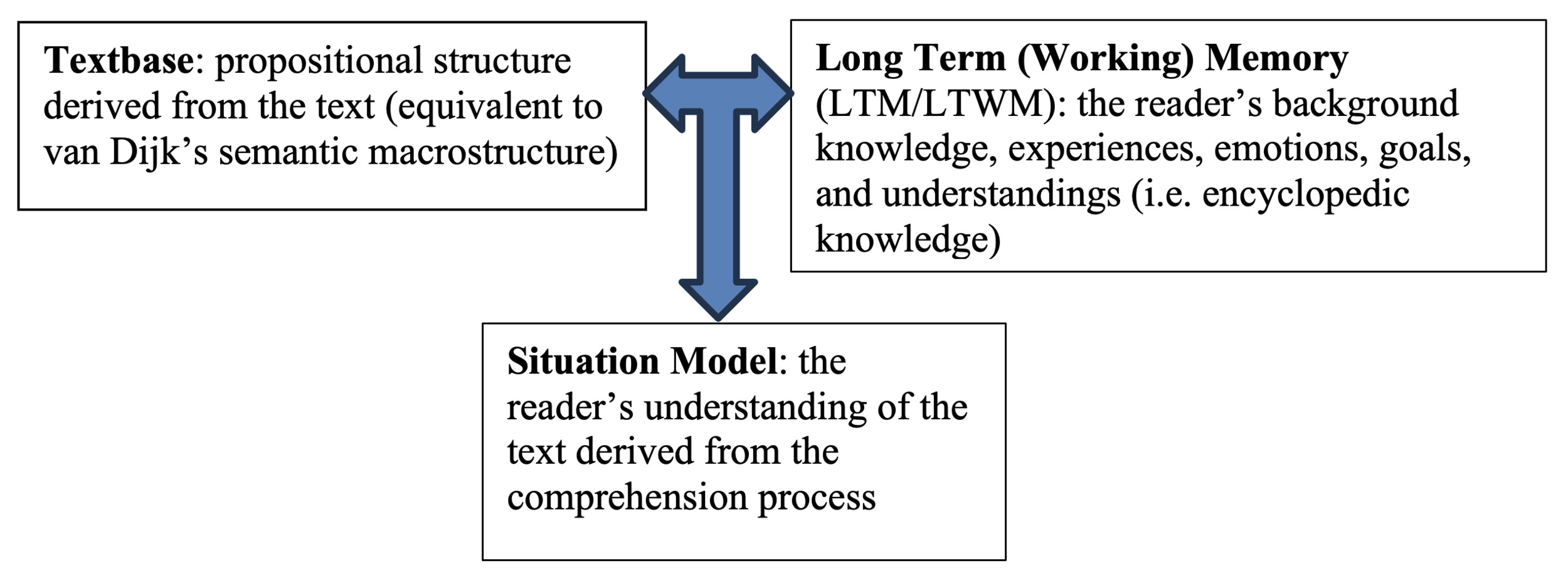
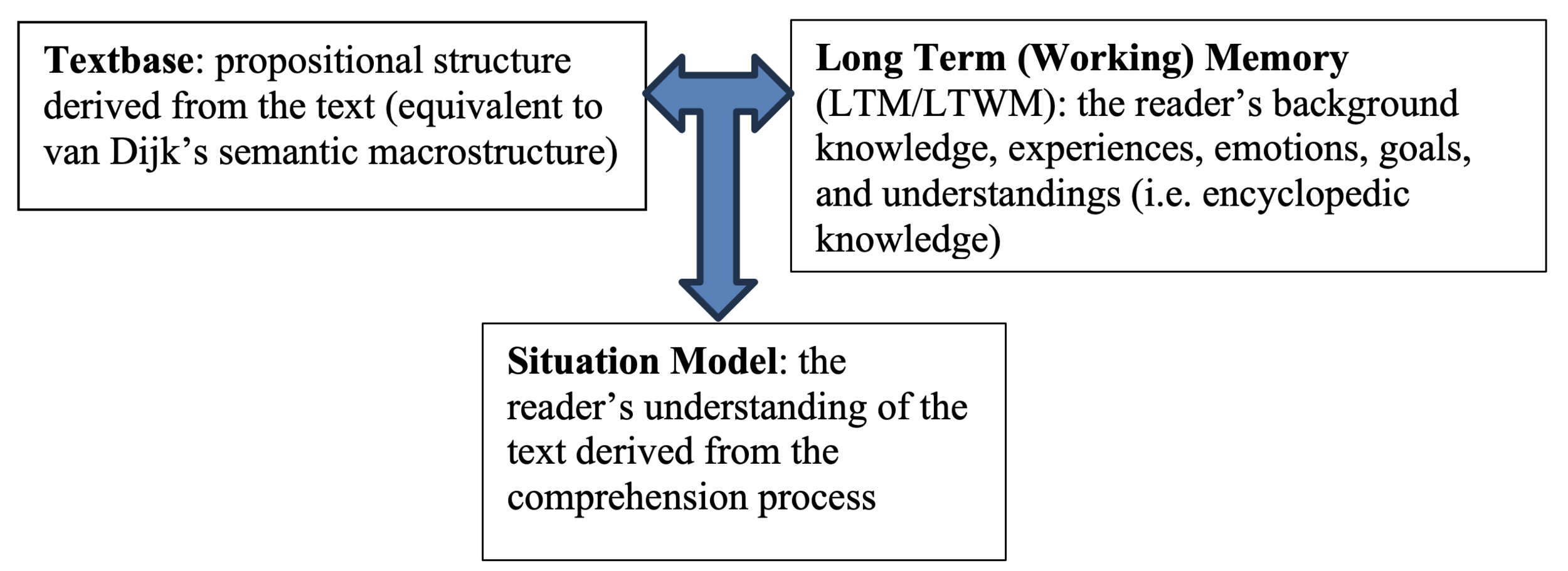
Kintsch identifies the various components of text comprehension. He begins by observing that the propositions derived directly from the text constitute the textbase. As part of the understanding process, information from long-term working memory (LTWM; i.e. encyclopedic knowledge such as genre conventions, schemas, experiences, ideological viewpoints, and emotions) is activated in order to supplement the textbase for a personal interpretation. The completely integrated structure of propositions from the textbase and propositions from LTWM constitute the situation model. The resulting inferred macrostructure is a hierarchically ordered set of propositions representing the global structure of the text with macropropositions at different levels of generality. The micro- and macrostructure of the textbase results from the semantic analysis of a text and its author-intended rhetorical structure. The reader’s mental representation results from the textbase plus knowledge elaborations and interpretations. These elaborations account for the reader departing from the author-designed textbase and restructuring it both locally and globally based on their knowledge or beliefs.
In terms of what is important for the macroanalysis of Scripture, Kintsch notes the signals within a text enabling the formation of macrostructure. These include titles, topic sentences, summary statements, various syntactic and semantic signals indicating importance, repetition, phonetic stress, cleft sentences, passives, clause structure, various foregrounding and topicalization devices, topic change markers, and cues regarding local coherence. Moreover, readers comprehend rhetorical superstructures and then construct schema-based macrostructures common to particular text types. Readers assign macropropositions to these schematic categories, simplifying the derivation of the overall organization. Even if the discourse context remains the same, knowledge nets will activate differently with the same reader on different occasions or with different readers. Nevertheless, context will constrain meaning construction so that readers will form similar concepts as they move from the local level and work upward hierarchically developing a global schema as the situation model develops.
The rise of reader-response criticism concerns some interpreters who seek to identify the author’s intended meaning as instantiated in the text as a fixed work. Kintsch’s work accounts for the divergence between the fixed meaning of a text and various readings by suggesting that comprehension depends (1) on the reader and the pragmatic situation, as well as (2) the text itself. The reader’s prior experience and goals determine the inferences that will be drawn from the text. Moreover, different assumptions among readers will lead to various meaning constructions since the situation model by definition is a form of inference produced automatically during the comprehension process by each reader on a given occasion. At the same time, inferences leading to the development of a situation model depend on communal knowledge and complex interpretation processes that may be shared by a social group or culture over prolonged periods.
For literary and complex texts, full understanding may require the construction of a spatial situation model or helps for visual representation since a reader’s textbase may achieve only a superficial understanding of the text. Moreover, reading a text removed from its original historical and cultural pragmatic situation may require the use of written or drawn spatial representations in order to grasp the text’s complexity situated within the original communicative environment. Therefore, a concern for the author’s intended meaning implies the need (1) to identify the social, historical, and religious context in which a text was authored, as well as (2) to identify a given reader’s assumptions that are in conflict with those of the author.[5] Fidelity to the author’s intended meaning will require the reader to adjust their own assumptions in order to approximate the original pragmatic situation in working toward a valid situation model with high fidelity to the text. This will result in lending a sympathetic ear to the otherness of the text’s voice.
One may identify several key concepts from Kintsch’s CI model that are useful for the macroanalysis of Ezekiel. First, the recognition and unmasking of prior beliefs, knowledge, attitudes, or ideologies from LTWM that would distort a faithful and accurate representation of the textbase in the mind of the ideal reader proves important. This could include a complete ignorance of the contents and global structure of Ezekiel, a naturalistic or Deistic worldview at odds with the emic theism of the book, an atomizing critical approach at odds with the linguistic indicators of cohesion, or a pathological fascination with apocalyptic literature that distorts the symbolism in Ezekiel beyond its contextual function and prominence. Kintsch’s description of the textbase and LTWM provides the conceptual framework for distinguishing between beneficial versus distorting background knowledge. This recognition provides the opportunity to harness reader-concerns by providing key global and background information needed to form an accurate textbase and situation model. Moreover, the need for summary representation aiding the recognition of global structure suggests the value of providing summarizing tables and figures of key structural features in order to help readers form an accurate textbase with a situation model faithful to it.
2.3. Relevance Theory and Inferential Communication
We now turn to Relevance Theory in order to explore the role of inference in cognitive text processing (Sperber and Wilson 1995; Blass 1990; Gutt 1991; Carston 2002; Blakemore 2002; Clark 2013). This approach helps account for the manner in which readers infer propositions at all levels of the propositional hierarchy when forming the textbase.
Whereas the code model of communication maintains that a speaker codes and the audience decodes a stable or fixed message in the communication process, Paul Grice and David Lewis instead proposed that some types of communication may instead be understood better as inferential in nature. According to this model, speakers produce interpretive evidence, and the audience infers the intended message from this evidence on the basis of partially overlapping knowledge and assumptions. Thus, speakers do not communicate all intended information explicitly. Following Sperber and Wilson (1995), complex communication involves both coding-decoding and the inferential model.
This, in turn, leads to the question of how an audience infers the correct interpretation intended by the speaker. According to the mutual knowledge hypothesis (or mutual manifestness) traditionally assumed by the code model, the context consists of the premises shared both by the speaker and audience and used to interpret the utterance. This context is a psychological construct of an activated subset of the hearer’s assumptions about the world. These assumptions draw from encyclopedic knowledge and include beliefs, memories, scientific hypotheses, general cultural assumptions, and beliefs about the speaker, among other factors.
However, even two speakers from the same speech community may reconstruct the same event differently because no two people share exactly the same encyclopedic knowledge set. As an alternative proposal, an inferential model of communication does not assume an exact overlap in mutual knowledge. Rather, the speaker provides direct evidence of the communicative intent for inferential or ostensive-inferential communication, and successful communication occurs when the audience infers the speaker’s intent from the evidence. The cognitive environment is a set of facts or assumptions available to an individual, and these manifest facts are perceived and make inference possible. The cognitive context shared between the speaker and audience cannot match perfectly always, and so this process works with asymmetrical coordination. When interconnected old and new items of information function as premises in the inference process, further new information may be derived that is relevant. The greater the derived information, the greater the relevance.
Key to the process of ostensive-inferential communication is communicative intent. Behavior manifesting an intention to communicate is ostensive behavior, and ostensive behavior provides evidence of the communicator’s thoughts. The principle of relevance may be summed up as the guarantee of relevance in the ostensive act of communication. Moreover, ostensive-inferential communication reveals to the audience the speaker’s intent in making manifest a basic layer of information. Therefore, for ancient literary texts the exegete’s goal remains the identification of literary superstructure by identifying the features of the text indicating the author’s communicative intent as revealed by choices in form, rhetorical features, and organization. This, in turn, provides evidence for a hierarchical macrostructure approximating the one intended by the author. This propositional macrostructure indicates both the basic layer of information communicated, as well as the communicative intent (i.e. the speech act or function).
Relevance theorists distinguish between explicatures and implicatures. An explicature communicates the logical form of an utterance explicitly, whereas an implicature does not. That is, the ostensive stimuli (i.e. linguistic utterances or text features) do not encode the logical form of the implicature. The presence of a semantically incomplete or manifestly vague utterance is a clear indication of where the logical form of the assumption schema may be enriched. Implicatures may either be implicated premises or implicated conclusions, which must be supplied by the audience. These will be the premises that are manifestly the most accessible in context. Similarly, the audience deduces implicated conclusions from the explicature and context. These are implicatures that in context seem most likely for the communicator to intend. Some assumptions and implicated conclusions may be stronger or weaker than others, and the weaker the implicature, the less confidence the hearer has that it reflects the speaker’s thoughts. To illustrate these concepts, an explicature would be “please close the door,” whereas with the explicature “it is cold in here” the speaker likely intends the implicature (or implicated conclusion) “please close the door.” Thus, for interpreting ancient texts, an inferential view of language suggests the need to identify the explicatures in the text, as well as implicated premises and conclusions. Implicated premises include assumed historical, cultural, or situation information, and implicated conclusions refer both to local micropropositional inferences, as well as the macropropositional summary or point of a unit (Hill 2006).
Thus, explicatures and implicatures perform a valuable communicative function. A good communicator attempts to create as great a contextual effect as possible while minimizing the processing effort to the greatest degree possible. A speaker aiming at optimal relevance will leave implicit everything the hearer is expected to supply with less effort than would be needed with an explicit prompt. The danger exists in an overestimation or underestimation of mutual understanding. When interpreting ancient texts, contemporary interpreters must identify these gaps in background knowledge created by historical, cultural, and linguistic distance, and provide them for contemporary readers in order to make the author’s intended message as accessible as it was originally. Furthermore, classical figures of rhetoric (e.g. repetition, gapping, parallelism) may guide the hearer to an intended contextual effect or interpretation by implicature.
In terms of speech acts, the principle of relevance makes it possible to derive inferences about the communicator’s intention. In accounting for the given interpretation, all that is required is that the ostensive stimulus should be enough to set the inferential process on the right track. Given the role of implicatures, this means the communicator does not need to represent or encode the informative intention in any detail. Grammatical and lexical indicators of illocutionary force may manifest an abstract property of the informative intent in order to point the audience in the right direction for seeking relevance (Sperber and Wilson 1995, 254).
First, in relation to macrostructure for Ezekiel, the juxtaposition of oracles, as well as key features of superstructure, lead the ideal reader to infer macropropositions regarding the relationship between oracles, groups of oracles, the interpretive significance of recurring phrases, and other features of book texture impacting the final propositional macrostructure. Second, the notion of implicated conclusion for translation suggests the need to test the macropropositional structure of a translation in order to determine the degree to which the inferred textbase in the language community reflects the likely interpretation of the literary structure of the original. Third, the relation between inference and speech act suggests the pragmatic function of a text may only be implied rather than stated explicitly in a complex literary work. Nevertheless, multiple linguistic indicators leading to this interpretation (or contextual effect) should be adduced from the text as warrant justifying this interpretation.
2.4. Oral-Derived Literature
Furthermore, the manner in which Ezekiel draws upon pentateuchal traditions merits a consideration of oral tradition.[6] Wardlaw (2015, 16–22) sketches a brief history of work on oral traditions in the Pentateuch and the Psalter. In fact, the investigation of oral tradition goes hand in hand with Form Criticism and the quest to discover the original pragmatic situation in which characteristic forms developed, as outlined by Hermann Gunkel (1922, 1929; 1966) and Sigmund Mowinckel (1967). However, rather than bogging down in the attempt to distinguish between oral and written literature, the present study adopts John Miles Foley’s application of performance theory by recognizing that literary tradition possesses roots in oral tradition and oral modes of transmission. This recognition of oral-derived literature proves helpful in dealing with a written style that has been impacted by an oral culture and oral modes of communication (Foley 1985; 1986; 1987; 1991; 1995; 2002; 2010).[7] For the identification of particular stylistic features, an approach recognizing oral-derived discourse seeks to identify the manner in which an author or tradent uses structural features, phraseology, or themes from a given culture’s repository of tradition in order for the ideal reader or listener to derive author-intended cognitive effects.
It is precisely at this point where the present investigation runs counter to typical form-critical work conducted alongside source and redaction criticism. At stake is the issue of what constitutes evidence for redactional layers and multiple redactors (i.e. with what assumptions will we begin in LTWM). In looking to the book of Ezekiel, it seems a far stretch to argue that the eyes inside the wheels in chapter one indicate a separate redaction, or that the placement of a salvation oracle alongside a judgment oracle indicates a separate redactional hand. This type of overly specific and subjective parsing of redactional layers lacks rigor and fails first to establish the characteristics of emic Israelite oral-derived literary style. One who fails to first identify emic modes of meaning construction may wrongly identify a cultural mode of communication foreign to twenty-first-century westerners as a “break” in the text. It seems as if redaction critics, more than 2,000 years and multiple cultures removed from the text they study, find every contrastive feature of literary structure to be evidence for separate literary hands when the case can be made that a single author from a distant culture employed emic compositional devices in order to construct a complex work as a vehicle for their message. Thus, in contrast to the systematic application of Cartesian doubt to traditional views of authorship, the present investigation instead adopts the more balanced philosophical approach of Hans-Georg Gadamer ([1960] 2004) by listening to the voice of tradition unless firm and unambiguous evidence casts suspicion upon it. Therefore, traditional accounts of a text’s authorship and provenance will be accepted, including the notion of a text’s unity, unless unambiguous evidence exists for multiple authors or redactors based upon features that cannot be attributed to emic modes of composition.
Therefore, the present investigation seeks to identify the manner in which the author of Ezekiel uses linguistic elements and traditional themes from Israel’s repository of traditions in order to lead the reader down a predetermined interpretive path (i.e. interpretive implicatures). This recognition suggests the need to identify key terms, phrases, and themes whose mention likely evoked larger frames of tradition for the audience in the original pragmatic situation. The following discussion will note several key features by which the language and superstructure of Ezekiel echoes pentateuchal traditions in general, and the book of Exodus in particular. This exploration of oral-derived linguistic features goes beyond the level of the book for macropropositional analysis, and extends to macro-canonical considerations. Thus, with an ear attuned to the warning of Brevard Childs (1979, 370–71), linguistic features in the book of Ezekiel will be interpreted for their semantic and pragmatic function in canonical context rather than pursuing the blinkered quest for redactional layers.
3. Analyzing the Macrostructure of the Book of Ezekiel
Discussion now turns to an application of these theoretical concerns to the book of Ezekiel. Discussion will consider (1) the overall book structure of Ezekiel, (2) the use of genre-related forms, (3) key rhetorical features of literary superstructure shaping the macrostructure of the book as the textbase for the ideal reader, and (4) oral-traditional materials used within Ezekiel’s literary structure for the construction of meaning.[8]
3.1. Canonically Arranged Sequence
Although macrostructure technically builds sequentially in the mind as the reader reads linearly, processing the text from the microlevel up to the macrolevel, Kintsch has demonstrated the reality of both top-down and bottom-up processes. Hermeneutic discussions mirror this process by stating the need to understand a text’s overall content and structure in order better to understand the details. Moreover, the early Church Fathers taught the need for understanding the scopus of Scripture in order to understand the details of the individual units and verses. Accordingly, we begin with an overview of Ezekiel’s literary superstructure in order to move toward an understanding of the book’s macrostructure.
With the exception of the Oracles Against the Nations (chs. 25–32), Ezekiel’s oracles appear to be grouped sequentially by date, and similar themes correspond roughly to these chronological groupings.[9] One may first observe that chapters 1–24 span six years early in Ezekiel’s ministry after the second and up to the third deportation from Jerusalem. This time extends from the fifth year of Jehoiachin’s exile in Ezek 1:2, up to the ninth year in 24:1 (approximately 592–588 BC). This first group of oracles largely contains warnings of disaster to come for Jerusalem and Judah because they violated the Mosaic covenant. Then chapters 25–48 contains warnings with calls to repentance, while also noting the hope to come. This second body of oracles opens with the Oracles against the Nations in chapters 25–32, and they do not progress chronologically: the 11th year (c. 586 BC; 26:1), the 10th year (c. 587 BC; 29:1), the 27th year (c. 570 BC; 29:17), the 11th year (c. 586 BC; 31:1), and the 12th year (c. 585 BC; 32:1, 17). However, the oracle sequence in chapters 33–48 does seem to be organized chronologically. A fugitive from Jerusalem came to Ezekiel on the fifth day of the tenth month in the 12th year (c. 585 BC; 33:21), and then on the tenth day of the month at the new year in the 25th year of exile and the 14th year after the city was struck down Ezekiel received the vision of the new city and land of Israel (c. 572 BC; 40:1). Thus, warnings of disaster before the final fall of Jerusalem and the third deportation occur in chapters 1–24. After the destruction of Jerusalem in 587 BC, hope for Israel may be found in chapters 25–48 with messages of judgment against the nations used instrumentally in chastising Judah (chs. 25–32), oracles calling Israel to repent and casting the vision of David yet to come (chs. 33–37), oracles recounting an eschatological enemy and divine deliverance (chs. 38–39), and a new divine vision for Israel in the land (chs. 40–48) culminating in God’s presence (48:35).[10] The ideal reader summarizes each oracle with a proposition as part of the textbase, and then relates the juxtaposed oracles organized by date or theme to one another by inferring a macroproposition higher in the hierarchy in order to make sense of the text through inferred discourse coherence.
This analysis of book structure will serve as an initial hypothesis, and it will be further refined during the course of form, rhetorical, and canon-tradition analysis.
3.2. Forms in Ezekiel
Both van Dijk and Kintsch note the importance of recognizing schemas in literary superstructure as the foundation for forming an accurate macropropositional representation of the textbase. Accordingly, we now turn to a consideration of characteristic forms identified by form critics in the book of Ezekiel, as well as their significance for understanding the book as a whole.[11] We will begin with the prophetic call narrative within chs. 1–3, and then consider other formulaic features throughout the book.
3.2.1. The Prophetic Call Narrative
N. Habel (1965) summarizes previous research on the form of the prophetic call narrative and its recurrence through Scripture (Figure 3; also see Long 1972; Buss 1981; Guyette 2015; Pikor 2020). Habel viewed the calls of Moses and Gideon in Exodus 3:1–12 and Judges 6:11b–17 as evidence for a literary Gattung within ancient Israel consisting of (1) divine confrontation, (2) an introductory word, (3) the commission, (4) an objection, (5) reassurance, and (6) a sign. Although this basic form existed, this does not preclude the development of this form, nor its rhetorical adaptation to a given context. The present discussion assumes both the historical primacy of Moses’ call narrative in Exodus 3:1–4:17 for all that followed in an oral-traditional culture, as well as its canonical significance, given narrative linearity. Call narratives have been identified for each of the major writing prophets (Isaiah, Jeremiah, and Ezekiel), which implies these prophets continue to apply the Mosaic covenant to succeeding generations (Deut 18:15–22). For the book of Ezekiel, this form at the beginning of the text relates Ezekiel to the Mosaic tradition and suggests the following materials are intended to be read as an application of the Mosaic covenant to the prophet’s pragmatic situation.
In terms of rhetorical distinctives, one notes that Moses’ call continues in 3:13–4:17 with the revelation of the divine name (3:13–15), a divine foretelling of the events about to unfold in Egypt (3:16–22), and Moses’ two further objections with signs given by the Lord (4:1–17). In contrast, (1) Ezekiel gives no explicit objection to his call; (2) rather than declaring Israel’s deliverance like Moses, Ezekiel will speak the words of lamentation, mourning, and woe from the scroll (i.e. the curses from Deuteronomy 27–30); and (3) whereas Moses was given signs both to reassure the Hebrews of their imminent salvation and to harden Pharaoh’s heart, Ezekiel is commanded to speak oracles against the rebellious house of Israel (2:3–3:11). Thus, it proves noteworthy that the only signs given through Ezekiel occur in the prophetic sign-acts emphasizing Israel’s coming judgment (3:22–7:27). Whereas Moses stood before stubborn Pharoah, whom the Lord chastised through acts of judgment (Exod 3:16–22), Ezekiel now stands before the stubborn house of Israel, whom the Lord will chastise (2:3–3:11). Similar to Isaiah before him (Isa 6:9–13), Ezekiel is called to a stubborn people and must remain a faithful watchman warning the people to turn from sin (3:16–21; 33:1–20). Moreover, within Ezekiel’s call the Lord gives the messenger formula כֹּ֥ה אָמַ֖ר אֲדֹנָ֥י יְהֹוִֽה, “thus says the Lord God,” and commissions Ezekiel to use these words to emphasize to a stubborn people that these messages possess a divine origin and authority (Ezek 2:4).
3.2.2. Formulaic Phrases and Forms in the Book of Ezekiel
Opening Formulas. We now turn to frequently occurring formulaic phrases within Ezekiel. From the beginning of the book, one encounters formulaic phrases in 1:3 directly following the date:
הָיֹ֣ה הָיָ֣ה דְבַר־יְ֠הוָה אֶל־יְחֶזְקֵ֙אל בֶּן־בּוּזִ֧י הַכֹּהֵ֛ן בְּאֶ֥רֶץ כַּשְׂדִּ֖ים עַל־ נְהַר־כְּבָ֑ר וַתְּהִ֥י עָלָ֛יו שָׁ֖ם יַד־יְהוָֽה׃
This opening demonstrates how these formulaic phrases may be employed in order to mark the beginning of a new oracle, as well as to indicate the source of the new oracle. Variants of the phrase ויהי דבר־יהוה אלי לאמר occur some 41 times at the beginning of an oracle (see below). Similarly, contextual variants of ותהי עלי שׁם יד־יהוה may be found either at the beginning or end of key visions or vision sequences (1:3; 3:14 [end]; 3:22; 8:1; 33:22 [end]; 37:1; 40:1). The Lord uses the address בן־אדם (2:1) around 93 times to directly address Ezekiel near the beginning of an oracle or with a change of topic, and 16 of these occurrences are found in the phrase ויאמר אלי בן־אדם. As noted above, the function and meaning of the messenger formula כה אמר אדני יהוה is defined within Ezekiel’s call in 2:4. Because the people are rebellious and hardhearted, the Lord directs Ezekiel to use this formula to remind them that the following oracles are of divine origin. Thus, this phrase occurs around 126 times either at the beginning of an oracle or within its body in order to emphasize the authority of the message. By way of contrast, the particle הוי, which typically occurs at the beginning of an oracle of woe, occurs only three times in Ezekiel (13:3, 18; 34:2).
Generic Boundary Markers. Two formulas marking oracle boundaries occur optionally either at the beginning or the end of the oracle. As noted above, variations of the phrase וַתְּהִ֥י עָלַ֛י שָׁ֖ם יַד־יְהוָ֑ה may occur either at the beginning or end of a vision oracle in order to mark its boundaries. Moreover, various constructions describing Ezekiel being lifted up or transported by the Spirit of God may mark the beginning of new oracles, a change of setting within a larger oracle complex, or the end of an oracle (3:12, 14, 24; 8:3; 11:1, 24 [end]; 37:1; 43:5).
Closing Formulas. One likewise finds characteristic formulas at the closing boundary of oracles, and these emphasize the authority of the message based upon its divine origin. The phrase אני יהוה דברתי occurs 14 times, whereas variants of נאם יהוה may either occur at the final margin of an oracle or optionally occur within its body in order to raise the prominence and underscore the authority of the statement. Variations of וידעו כי אני יהוה occur some 70 times and may be found near the final margin of an oracle, optionally near the end of smaller units within a larger oracle (e.g. 7:4, 9, 27), or within the body.
Therefore, one may conclude the phrases ויהי דבר־יהוה אלי לאמר and ותהי עלי שׁם יד־יהוה primarily mark the initial discourse boundary of an oracle, whereas אני יהוה דברתי functions to mark the end of an oracle in Ezekiel. The phrases בן־אדם and כה אמר אדני יהוה may occur near the beginning of oracle, or they may optionally occur near the beginning of smaller units within a larger oracle. Similarly, נאם יהוה and inflectional variants of וידעו כי אני יהוה may mark the final boundary of a discourse or occur within the body of the oracle in order to emphasize the origin and authority of the message.
When moving from one culture to another, some translation teams may decide these formulas are unnatural in the target language and omit them. However, the preceding discussion noted their function both to mark oracle boundaries and to indicate the authority of the message delivered by the prophet. Therefore, a translator seeking to preserve both the semantic and pragmatic function of these phrases in the Target Language will seek a natural equivalent both for marking discourse boundaries, as well as pragmatically emphasizing the divine origin and authority of the message. Deleting them because the team thinks they are bad style results in the omission both of structural discourse features and the pragmatic markers indicating these oracles are of divine origin. Cumulatively, in terms of speech act and the pragmatic situation, the use of these emphatic constructions throughout the book conveys a sense of urgency for Jerusalem and Judah to repent as the people stand on the brink of judgment in chapters 1–24, as well as the call to repent as the people experience the judgment of exile in chapters 25–48.
Oracle Forms. The comparatively brief oracle in Ezek 21:1–7 (Eng; Heb 21:6–12) illustrates how these formulas may be used. This oracle occurs within the larger unit when the elders seek the word of the Lord from Ezekiel in 20:1–23:49. The basic structure of this oracle occurs as follows:
6וַיְהִ֥י דְבַר־יְהוָ֖ה אֵלַ֥י לֵאמֹֽר׃
7בֶּן־אָדָ֗ם שִׂ֤ים פָּנֶ֙יךָ֙ אֶל־יְר֣וּשָׁלִַ֔ם …וְאָמַרְתָּ֞ לְאַדְמַ֣ת יִשְׂרָאֵ֗ל
8כֹּ֚ה אָמַ֣ר יְהוָ֔ה
הִנְנִ֣י אֵלַ֔יִךְ וְהוֹצֵאתִ֥י חַרְבִּ֖י מִתַּעְרָ֑הּ …׃
9יַ֛עַן אֲשֶׁר־הִכְרַ֥תִּי מִמֵּ֖ךְ צַדִּ֣יק וְרָשָׁ֑ע
לָ֠כֵן תֵּצֵ֙א חַרְבִּ֧י מִתַּעְרָ֛הּ אֶל־כָּל־בָּשָׂ֖ר מִנֶּ֥גֶב צָפֽוֹן׃
10וְיָֽדְעוּ֙ כָּל־בָּשָׂ֔ר כִּ֚י אֲנִ֣י יְהוָ֔ה הוֹצֵ֥אתִי חַרְבִּ֖י מִתַּעְרָ֑הּ לֹ֥א תָשׁ֖וּב עֽוֹד׃ ס
11וְאַתָּ֥ה בֶן־אָדָ֖ם …
12נְאֻ֖ם אֲדֹנָ֥י יְהוִֽה׃ פ
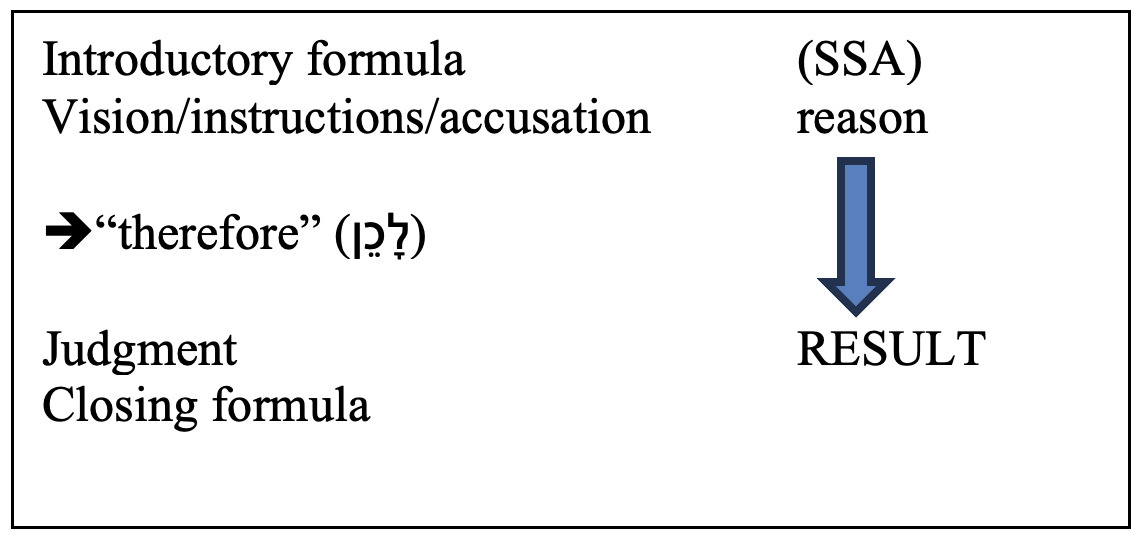
One notices the typical opening formula in 21:1–2 (Heb vv. 6–7), as well as the vocative address to Ezekiel, “son of man.” Then in 21:3 (Heb v. 8) one finds the messenger formula, “thus says the Lord.” The reason-RESULT relation occurs in 21:4 (Heb v. 9) with the construction “because … therefore ….” Then an echoic variation of the knowledge formula “then all flesh will know that I am the Lord” occurs in 21:7 (Heb v. 10). The oracle continues in 21:6–7 (Heb vv. 11–12) and begins with the “son of man” direct address and closes with the formulaic “declares the Lord God.” The structure of a prophetic sign-act may be observed as in Table 6.
Although occurring less frequently, the book of Ezekiel also includes laments (קִינָה) using the qinah 3+2 meter (Ezek 19:1–14; 26:17–18; 27:1–36; 28:11–19; 32:1–16; sim. “wailing” 32:17–32), three oracles of woe (Ezek 34), and salvation oracles (Ezek 28:25–26; 29:21; 34:25–31; 36:22–38). The key introduction and endings to these qinah texts may be seen in Table 7.
In addition to these oracles, Block (1997, 15) identifies legal addresses (rib; 14:12–15:8), figurative addresses (meshalim; 17:1–24), disputations (ch. 33), and other miscellaneous forms. However, Zimmerli (1979, 21–41) provides a simpler and more helpful categorization scheme when he identifies the vision, the sign-act (including mashal, chidah, and qinah), and the disputation-oracle. Similarly, although Westermann (1960; 1987) performs a detailed analysis of form types, he also provides more general and overarching categories for prophetic literature when he collapses everything into (1) judgment oracles and (2) salvation oracles, followed by more detailed categories. In this same vein, Hoyt (2019) seeks to identify emic categories in Amos and concludes there are three (qinah, rib, and oracle of salvation). Although it is necessary for specialists when identifying the genesis of the forms and their associative semantic complexes, multiplying genre forms within Ezekiel proves cumbersome for the common interpreter or translator. This seems true in the light of the frequency with which judgment oracles occur throughout the book (vid. the recurrence of משׁפט and related words). Other forms are interspersed infrequently, such as the laments in the oracles against Egypt (chs. 29–32) or the disputations in chapter 33. A simplified genre template for the judgment oracle predominating in Ezekiel is found in Figure 4.
.png)
This discussion of formulaic phrases and schemas in the book of Ezekiel demonstrates both the formal, literary superstructure, as well as the typical semantic macrostructure useful in LTWM for recognizing rhetorical adaptations in given contexts. The rhetorical adaptation of these forms carries pragmatic implications for macroanalysis and interpretation. Moreover, the formulaic phrases carry a pragmatic function cumulatively greater than their function within the immediate context. As noted above, the repetition of these formulas throughout the book convey both the stamp of the Lord’s authority and a sense of urgency to repent due to imminent and realized judgment. Finally, the structural date formulas and oracle boundary formulas provide indicators for unit breaks, suggest units for determining inferred macropropositions, and also indicate cohesion between disparate oracles throughout the book.
3.2.3. Prophetic Sign-Acts
One major form found throughout the prophets includes the prophetic sign act, and Ezekiel is no exception. The Lord repeatedly instructs Ezekiel to perform actions with various objects in order to symbolize the judgment coming against Israel and other nations (Ezek 3–5; 12; 21; 24), as well as the future hope for the restoration of Israel through the house of David (37:15–28). The Lord provides a message for Ezekiel to declare in order to interpret each of these acts as he performs them.
3.2.4. Allegories, Parables, and Proverbs
Allegories, parables, and proverbs occur throughout Ezekiel.
These may occur as an extended metaphor and without overt indication that it is a parable (e.g. 15:1–8), or the Lord may explicitly instruct Ezekiel to speak a חִידָה, “riddle,” or מָשָׁל, “proverb” (e.g. 12:22; 17:2). As with the allegory in qinah form in 19:1–14, forms may be combined for stylistic effect.
3.3. Key Macro-level Rhetorical Features in Ezekiel
From features of form, we now turn to key rhetorical features of literary superstructure impacting the inference of macropropositions, their placement within the propositional hierarchy, and macrostructure. The key features we shall examine include inclusio, recurring vocabulary and phrases, and peak-marking.
3.3.1. Inclusio in Ezekiel
We noted above that a combination of date formulae and thematic grouping in Ezekiel suggests the book may be divided into two parts, chapters 1–24 and chapters 25–48. The first half of the book contains oracles fitting the pragmatic situation of the time between the second deportation (597 BC) and Nebuchadnezzar’s siege of Jerusalem (588 BC). The oracles within the second half of the book date to the period from the fall of Jerusalem through the 27th year of captivity (587–571 BC). With this change in pragmatic situation there is a corresponding change in content and emphasis within the oracles. The emphasis on the judgment of Jerusalem with the possibility of repentance and brief glimpses of hope in the first half of the book shifts to an emphasis on the judgment of the nations used instrumentally to chastise Jerusalem, the judgment of the wicked within Israel, and a heightened prominence in the call to repentance and the vision of salvation within the second half of the book. Two inclusiatory features heighten both the thematic cohesion between these major units, as well as the contrastive development of the implicit call to repent and dwell in the presence of the Lord that grows through to the end of the book.
First, one notes the oracle of the watchman characterizing Ezekiel’s ministry in 3:16–27, which is then repeated with development in 33:1–20. This repetition within the literary superstructure (1) heightens the prominence of these oracles within the macropropositional hierarchy, (2) functions as a structural indicator of cohesion between the two halves of the book, and (3) highlights the nature of the thematic development of Ezekiel’s message from the pragmatic situation preceding the destruction of Jerusalem to the situation following. Typical formulaic phrases mark the boundaries both before and after each of these oracles.
In terms of content, the message in chapter 3 is an implicit command for Ezekiel to warn the inhabitants of the city lest the Lord hold him accountable for their blood. The oracle in chapter 33 echoes the phrasing from chapter 3 and expands upon it in 33:10–17 with a direct message for the watchman to deliver to the people (see below). This echo and development in chapter 33 introduces the greater prominence the explicit call to repentance has within the macrostructure of the second half of the book.
With the shift in pragmatic situation from a time preceding the judgment of Jerusalem to the time following it, the Lord’s purpose in Ezekiel’s ministry now changes. With judgment accomplished, the prominence of the call to repent and the future promise of deliverance and salvation grows.[12] The implicit command for Ezekiel to warn the inhabitants of the city in chapter 3 introduces the judgment oracles in the first half of the book, whereas the use of the disputation form in chapter 33 emphasizes the call to repent and introduces the greater hope through repentance and salvation in the second half.
The repetition and augmentation of the parable of the watchman raises its prominence in the macrostructure of the book. Moreover, its occurrence at the beginning of two major sections may indicate the need to revise the major book division proposed above. The initial warning in 3:16–21 focuses on the responsibility of the watchman-prophet to warn the inhabitants of the city regarding coming judgment. This is then followed by judgment oracles against Israel in 3:22–24:27, and against the nations in chs. 25–32. The warning is then echoed and expanded in 33:1–20, and the expanded materials focus on the wicked turning in repentance. This expanded form introduces the similar thematic shift with greater prominence given to repentance and renewal in chs. 33-48. Therefore, this macrostructural consideration suggests the need to revise the major book division as follows. This structural analysis roughly follows that of C.F. Keil (Keil and Delitzsch 1866–1891, 9:6).
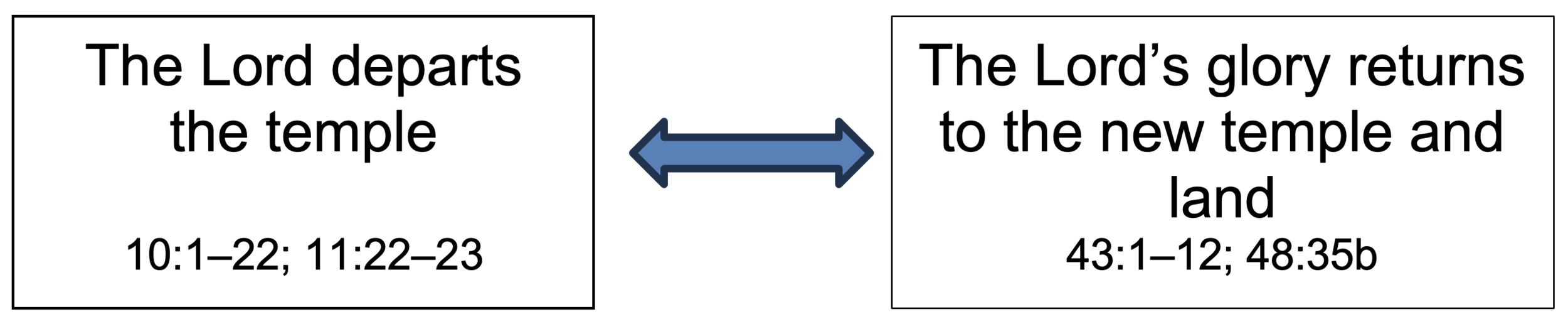
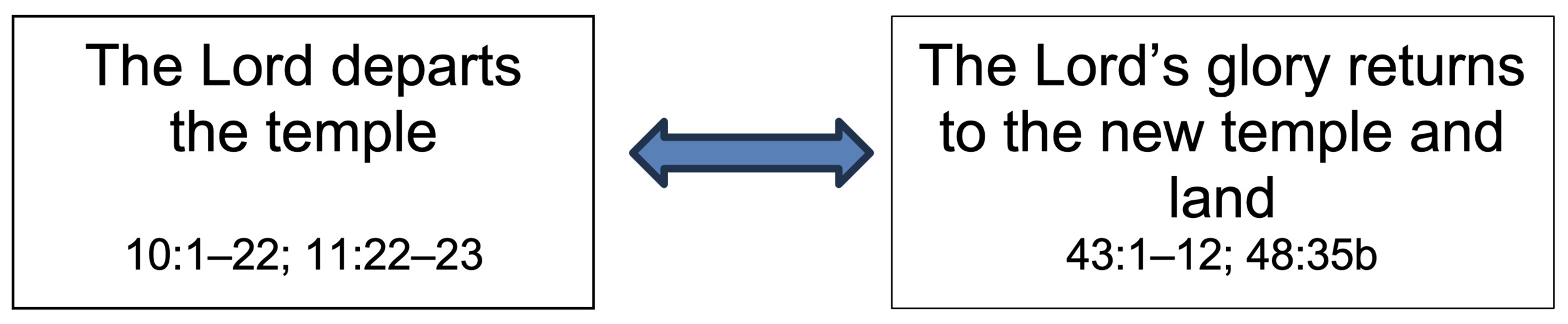
Second, the contrastive and inclusiatory theme of the Lord’s presence further unites both halves of the book. Whereas the cherubim and the glory of the Lord depart the temple and Jerusalem (10:1–22; 11:22–23) due to the sins of Israel (chs. 8–11), the hand of the Lord comes upon Ezekiel in chapters 40–48 in order to give him a vision for a new temple, a renewed Zadokite priesthood, a new city, and a new allotment of the land where the glory of the Lord will dwell in the midst of a renewed and penitent Israel (43:1–12; 48:35b). The departure of the Lord’s glory from the temple corresponds to the messages of imminent judgment and the destruction of the temple in the first half of the book, whereas the return of the Lord’s glory corresponds to the message of repentance, the renewal of the house of Israel, and the new temple in the second half of the book (e.g. 37; 40–48).
3.3.2. Recurrence: “They Will Know”
Discussion now turns to a prominent phrase recurring throughout the book of Ezekiel, and a phrase that carries significant traditional overtones. Although several formulaic phrases were discussed above, purpose and result statements using the “that/then they will know” (וידעו כי אני יהוה) formula are augmented and developed throughout the book (Block 1997, 38; Evans 2019). These statements may occur as a closing formula or within an oracle, and the echoic recurrence of this phrase raises its prominence to book-level, macrostructural significance. One observes that this phrase regularly occurs throughout the judgment oracles both against Israel and the nations in chapters 1–39, as well as within the salvation oracles for Israel.[13]
One elsewhere finds the theme of the knowledge of the Lord in Exodus (Eslinger 1996; Blackburn 2012; Alexander 2017, 1–4).[14] In Exod 5:2 after Moses reports the Lord’s command to let Israel worship, Pharaoh asks, “Who is the Lord?” and declares that he does not “know the Lord.” The key connotation of this phrase emerges in Exod 6:7 when the Lord declares He will take Israel as His people, “and you will know that I am the Lord your God who brings you from the servitude of Egypt.” Conversely, Egypt “will know that I am the Lord when I stretch out My hand against them and bring Israel from their midst” (7:5). The remaining occurrences augment these two central concepts that (1) the Lord’s people know Him through His acts of salvation, and (2) the Lord’s enemies know and recognize Him through His acts of judgment. Thus, the knowledge of God through judgment and salvation is a double-edged sword. Through contextual usage in Exodus, the narrative augments the idea of the Lord’s incomparability (Exod 8:6; 9:14), that the events of the exodus are to be related to the next generations that they may know the Lord (Exod 10:2), that the Lord is greater than all other supposed gods (Exod 18:11), that the Lord delivered Israel in order to dwell in their midst (Exod 29:46), and that the Lord sanctifies Israel (Exod 31:13). The two core concepts that (1) salvation reveals a knowledge of the Lord to His people, and (2) judgment reveals the knowledge of the Lord to His enemies are then taken up in Ezekiel, while the occurrence in Exod 29:46, “and they will know that I am the Lord their God who brought them from the land of Egypt to dwell in their midst,” could very well be seen as the conceptual backdrop for the use and development of this phrase in the book of Ezekiel. Indeed, this phrase builds toward the climactic vision of return, renewal, and the Lord’s presence in chapters 40–48.
Thus, the book of Ezekiel takes up this traditional phrase from Exodus and exploits it as a major structural device. Its recurrent usage within the literary superstructure raises its prominence within the propositional macrostructure. As in Exodus, the Lord’s wrathful judgment against those in opposition, in this case rebellious Israel, will lead them to know that the Lord has spoken (Ezek 5:13; 17:21), and judgment will lead them to know that He is the Lord (וידעתם כי־אני יהוה; 6:7). Just as this formulaic phrase was also associated with salvation for God’s people in Exodus, the Lord promises to reestablish His covenant (16:59–63) “and you will know that I am the Lord” (v. 62). Just as the Israel obeyed the Sabbaths in order to know the Lord sanctified them (Exod 31:13), Ezekiel declares the Lord gave the Sabbath as a sign that Israel may know He sanctifies them (לדעת כי אני יהוה מקדשׁם; 20:12).
However, this knowledge formula does not apply only to Israel within the book of Ezekiel. The Lord’s judgment will lead “all flesh” to know that He is the Lord (21:10), as recurrence in the Oracles Against the Nations demonstrates (e.g. 25:5).
Nevertheless, in contrast to the nations, the Lord will raise up a horn for the house of Israel “and they will know that I am the Lord” (29:21, an oracle of salvation). Then the knowledge formula in relation to judgment continues in what some refer to as “the Gospel of Ezekiel” in chapters 33–37 (e.g. 33:29), while at the same time it occurs within the more prevalent oracles of salvation (34:27, 30). On the one hand, this may be augmented to include an echo of the theme of the Lord’s presence from Exodus, as in וידעו כי אני יהוה אלהיהם (34:30//Exod 3:12). On the other hand, the author also adapts this formula to indicate the nations will know the Lord as the result of Israel’s salvation (וידעו הגוים כי־אני יהוה, 36:36; וידעו הגוים אשׁר ישׁארו סביבותיכם כי אני יהוה, 36:36), and that the Lord sanctifies Israel (וידעו הגוים כי אני יהוה מקדשׁ את־ישׂראל, 37:28).
Next, within the oracle of Gog and Magog, the knowledge formula continues to be associated with judgment (38:23; 39:6). With the destruction of Gog and Magog and the salvation if Israel, the Lord will cause His holy name to be known in the midst of Israel so that the nations will know that the Lord is the Holy One of Israel (39:7). The Lord will set His glory among the nations, will return all of the exiles to their own land, and Israel will know the Lord from that day forward (39:22, 28). However, it remains noteworthy that this knowledge formula does not occur in the climactic vision of chapters 40–48.
3.3.3. Peak-Marking
Longacre (1996, 33–50) notes some of the various methods by which an author or tradition may mark the peak of a narrative. One such device is rhetorical underlining, where an author may use various rhetorical devices, including extra words, in order to slow down the narrative and bring focus upon the important point of the story. The book of Ezekiel as prophetic literature is hortatory rather than narrative, and the author marks the peak of the exhortation by lengthening the date formula at the height of the discourse in 40:1. The phrase “In the twenty-fifth year of our exile, at the beginning of the year, on the tenth day of the month, in the fourteenth year after the city was struck down, on that very day” proves to be the longest date formula within the book (see below). In addition to the date formula, the vision itself in chapters 40–48 proves to be the longest in the book. Both of these features together indicate the emic peak occurs with this final vision detailing the new temple, the renewed priesthood, and the new allotment of land in preparation for the presence of the Lord.
Therefore, the various preceding oracles, structural devices, and rhetorical devices function to heighten the message in leading up to this climactic passage emphasizing Israel’s future hope. In terms of the macrostructure, this raises the prominence of chapters 40–48 and suggests the macroproposition for this unit will be high in the propositional hierarchy. All preceding materials, including the initial vision of Ezekiel’s call (1:1–3:15), the temple vision (chs. 8–11), the oracles against the nations (chs. 25–32), and what some refer to as the Gospel of Ezekiel (chs. 33–37) build toward the vision of the Lord’s presence in a new temple and a new land following the chastisement of exile, repentance, and the renewal of Israel.
3.4. Oral-Traditional Echoes
From this discussion we see there is a constellation of phrases and themes largely echoing Exodus. Given the parallels between God’s people dwelling in servitude both in Egypt and in Babylon, Ezekiel uses the traditional materials from Exodus in order to reappropriate them by analogy in order to provide a framework for understanding Israel’s exile and future restoration as a second exodus from bondage (Ezekiel 40–48). This proves suggestive for identifying links between the first and the second exodus (Gentry 2017, 71–92). Although these linguistic features have been discussed by form and redaction critics (e.g. Walther Zimmerli), their methodological framework for the history of composition and the various dating schemes for the composition of the Pentateuch in relation to the Prophets does not recognize these author-intended echoes of earlier pentateuchal traditions.
3.4.1. Ezekiel’s Call (1:1–3:15)
The formal parallels between the call of Moses in Exod 3:1–4:17 and the call of Ezekiel in 1:1–3:15 were discussed above. In addition, other echoes reinforce the intentional links between the two texts. Just as the Lord appeared to Moses in a flaming bush, the Lord likewise appeared to Ezekiel with fire (1:4, 27). Just as Moses was herding sheep for his father-in-law Jethro on the back side of the desert, and just as Moses received and conveyed the Lord’s commands to Pharaoh in a foreign land, the hand of the Lord now comes upon Ezekiel by the Chebar canal in the land of the Chaldeans (1:1–3). Whereas the Hebrews were enslaved in Egypt, Israelite captives are now enslaved by exile to a foreign land.
3.4.2. “That They May Know That I Am the Lord”
The recurrence of the phrase “that they may know that I am the Lord” and its variations in Ezekiel was discussed above. In Exodus, the Lord’s acts of judgment against Pharaoh and salvation for Israel are the means resulting in the knowledge of the Lord. Whereas for Egypt the knowledge of the Lord resulted in judgment, the knowledge of the Lord for Israel through the exodus resulted in them experiencing the presence of the Lord by mercy and grace. This phrase recurs more prominently in Ezekiel and functions similarly. Its use in the judgment oracles indicates that those who have rebelled against the Lord in Israel, as well as the rebellious nations, will experience judgment resulting in the knowledge of the Lord. Conversely, those who repent and are revived by the Spirit of the Lord (Ezekiel 33–37) will know the Lord who sanctifies them (Ezekiel 38–39).
3.4.3. The Oracles Against the Nations
From Moses’ call in Exodus 3 through to the destruction of Pharaoh’s army in Exodus 14, Moses repeatedly called for Pharaoh to let the Hebrews go and worship the Lord in the desert. This call was punctuated with signs and the ten plagues as acts of judgment. Just as Moses declared judgment upon Egypt, one half of Ezekiel’s oracles against the nations (Ezekiel 25–32) concern the Lord’s judgment against Egypt and Pharaoh (chapters 29–32). The lament form occurs in chapters 30 and 31 within the oracles declaring a second destruction of Pharaoh and his entire army (32:31–32).
3.4.4. The New Temple and Land in Ezekiel 40–48
It is noteworthy that the materials in chapters 40–48 echo the instructions for building the Mosaic tabernacle (Exodus 25–31), as well as the buildup to the glory of the Lord resting in Israel’s midst after Moses followed each of the Lord’s commands (Exod 40:34–38; Ezek 43:1–12; 48:35b). Just as the presence of the Lord in Israel’s midst within the tabernacle was the climax of the book of Exodus, the presence of the Lord in a renewed Israel is the climax of the book of Ezekiel. This echoic remembrance casts Ezekiel as a contemporary application of the Mosaic covenant in the days of the chastising exile.[15]
3.4.5. Legal Material Incorporated in Ezekiel 40–48
As noted by Zimmerli (1979, 1:35), priestly rituals emerge within the Temple Narrative (43:18–27; 45:18–20; 46:2, 12), apodictic priestly laws are found (44:17–31), instructions for temple worship in the style of the priestly writer are found (45:21–46:12), and the borders of the land are described akin to Numbers 34 (45:1–8; 47:15–20; 48).
3.4.6. Torah Vocabulary in Ezekiel
In addition to the abovementioned echoic phrases and thematic elements, pentateuchal legal vocabulary also occurs within Ezekiel as a further indicator that Ezekiel’s ministry continues the priestly and prophetic tradition of Moses. The noun תורה, “law,” occurs 7 times in such contexts as “the law will perish from the priest” (7:26), and “they shall judge with my laws and statutes” (44:24).[16] Similarly, the word משׁפט, “judgment,” in reference to Mosaic Torah occurs around 16 times out of a total of around 46 occurrences of this form.[17] Often this word can refer to the Lord’s general acts of judgment against Israel or the nations, or more generally as the standards of the foreign nations.[18] For example, the Lord accuses Israel, “you have not obeyed my judgments, but you acted according to the judgments of the nations around you” (11:12). Similarly, the Lord declares concerning future Israel, “My Spirit I shall set in your midst, I shall cause you to walk according to My statutes, and you shall keep my judgments and do them” (36:27). The word חקים, “statutes,” occurs around 22 times in Ezekiel. In the majority of occurrences, the Lord accuses Israel of not walking in obedience to His statutes (e.g. 20:11, 13, 16, 19, 21, 24).[19] This recurrence of references to Torah using vocabulary from the legal domain further strengthens the ties between Moses and Ezekiel in casting Ezekiel’s prophetic message as an application of the Mosaic covenant to Ezekiel’s generation (i.e. the pragmatic situation). Thus, Ezekiel continues the Mosaic ministry and message to a rebellious and stubborn people, who will experience judgment followed by a second exodus.
4. Conclusions
The preceding discussion summarized key ideas from the work of Teun van Dijk and Walter Kintsch, as well as Sperber and Wilson, which provided the theoretical framework for approaching the macroanalysis of the biblical text. The present investigation noted van Dijk’s distinction between literary superstructure and semantic macrostructure. Both the routine forms of a text and its distinctive rhetorical features influence the formation of a semantic macrostructure. Second, Walter Kintsch’s CI model provided the theoretical framework for articulating how a reader may form a cognitive textbase that is faithful to the literary superstructure of the text itself. In terms of reader-concerns, key global information regarding the text’s organization, as well as relevant background information in LTWM aid the reader in forming a more accurate textbase. In contrast, the reader’s ignorance of a text’s organization and pragmatic situation, background assumptions at odds with the text, or interests or values at odds with the text may lead to a distortion of the textbase resulting in a pathological reading and situation model. Third, considerations from Relevance Theory provided an understanding of how the literary superstructure of a text leads to the inference of macropropositions and their hierarchical placement within the overall semantic structure of a reader’s cognitive textbase. Moreover, discussion noted that all information does not need to be communicated overtly. Rather, a good author will provide the least amount of interpretive information possible in order to lead the ideal reader to infer the largest meaning complexes possible. Fourth, the present discussion incorporates Foley’s work in oral-derived literature in order better to understand how Ezekiel employed the emic devices and pragmatic functions of echoic phrases from Israel’s repository of traditional materials. The intentional and recurrent use of traditional materials were not (mis)read as indicators of redactional levels, but rather as features of literary superstructure from which the author intended the skilled reader to infer a surplus of meaning (i.e. a macroproposition within the textbase).
In terms of a general method for reading Scripture, these considerations suggest the need to (1) identify the genre and any expected book-level forms or schemas, (2) note any features indicating larger discourse structures or unit divisions, (3) identify lower-level forms or schemas, (4) note departures from typical forms for rhetorical analysis, as well as how these devices may impact the placement of macropropositions within the propositional hierarchy, and (5) note any dependence on phraseology or themes from elsewhere in canonical tradition. In terms of helps for recognizing macrostructure and an accurate formation of the textbase in cognition, this would suggest the need for tabular and/or pictorial representations of macrostructure, descriptions of the original historical and cultural environment needed for understanding the pragmatic situation, as well as introductory discussions identifying common features of LTWM distorting an understanding of the textbase in a given culture or reading community.
This method was applied to the book of Ezekiel in order to identify overall book structure, various formal features, rhetorical features, and also the emergence of language and themes from Israel’s repository of traditional materials contained within the canon. Discussion noted the recurrence of themes from Exodus, such as the knowledge of the Lord through judgment and salvation, as well as the Lord’s presence among His people. Moreover, the similarities between Moses and Ezekiel’s calls, echoic phrasing, and the use of pentateuchal vocabulary casts Ezekiel as a prophet in the Mosaic tradition whose message applies the Mosaic covenant to the pragmatic situation of the exile. Just as the Lord brought the Hebrews from slavery and out of Egypt through Moses, the Lord now calls Israel from exile through Ezekiel.
For Bible translation, the results of this study suggest the need to concord echoic vocabulary and phrasing in order for Target Language communities to make the connections between Ezekiel and the Pentateuch for maximal contextual effects (i.e. implicated interpretive conclusions). Second, the formal features structuring the book suggest the need for translators to retain equivalent formal features in the Target Language in order to preserve both oracle boundaries, cohesion between oracles, and the pragmatic effect of the heightened call for the Lord’s people to repent lest they face judgment. Moreover, retaining the equivalent of these structural features at the macrolevel builds upon the call to repent by emphasizing that chastising judgment is not an end. Rather, chastisement itself is a call to repent and results in the Lord’s merciful hope, holiness, and restored presence in a new temple in the midst of His people. The failure to render the equivalent of these formal features results in a loss of macropropositional content. Therefore, it remains for the translator to explore various options for retaining these features in cultures where these forms may at first be seen as poor style and in order to maintain the fidelity of the translation in relation to the source text.
In relation to critical theories and methods, this discussion highlighted the need to identify emic meaning constructions within ancient texts rather than foisting contemporary cultural assumptions and methodologies back in time. Methods that are insensitive to emic meaning structures lead to pathological readings, and they result in an infelicitous formation of the textbase. Moreover, the identification of traditional echoes within the book of Ezekiel suggests that pentateuchal traditions were well established in Israel preceding the exile. The manner in which the structure of Ezekiel echoes these traditions under the assumption they would be understood by an exilic audience suggests that by the time of the exile they permeated common Israelite cultural knowledge to such a degree that Ezekiel could mention echoic phrases explicitly with the expectation that his audience would draw the correct interpretive implicatures based upon these implicated premises. Ezekiel expected his audience to enrich these explicatures based upon this contextual knowledge in order to attain maximal contextual effects.
In addition, methods and tools from discourse analysis will also be applied at key points in the following discussion (Callow 1974; Grimes 1975; Brown and Yule 1983; Longacre 1996; Longacre and Hwang 2012; Beekman et al. 2018; Scacewater 2020). Particular discourse considerations include linear organization, plot and peak marking, propositional analysis and relations (Semantic Structural Analysis), information structure, cohesion, reference, speech acts, and the identification of emic rhetorical devices.
For a systematic presentation of propositionalizing a text and identifying its semantic relations as a tool for translation, see Larson (1998, 305–378).
See van Dijk (1985) for various applications of this macroanalytic approach to discourse and various literary genres.
For the interaction between top-down and bottom-up processes, see Kintsch (2005).
For the book of Ezekiel, a description of the author’s historical context is provided in the introduction to most good commentaries (e.g. Block 1997), as well as introductions to the prophets, such as Clements (1996) and Smith (2014, 85–98).
Ezekiel’s reliance upon the Holiness Code (Leviticus 17–26) is well documented by commentators and scholars. For Ezekiel’s dependence on other pentateuchal literature in an oral world, see Gile (2021, 1–2). Within this oral context, attention has also been drawn to the relation between Ezekiel and wisdom (Arthur 2024).
In contrast to the oral-derived approach of this discussion, Evans (2006) and Cook (2018) trace the literary development of Ezekiel under the assumption the book possesses no preliterary oral prophecy (cf. Zimmerli 1979). With a more nuanced approach, Greenberg (1983; 1997) focuses on interpreting the MT as a work rather than analyzing orally delivered oracles. The present discussion focuses on the MT as the locus of meaning, while considering the pragmatic situation both of the original delivery and the extant canonical context.
For introductions to prophetic materials and their key characteristics, see Wendland (2014), Smith (2014), and Gentry (2017). For a contrast and comparison of the diachronic and synchronic approaches for analyzing Ezekiel, see Tooman and Barter (2017).
Even though the Oracles Against the Nations in their extant form are not dated sequentially, all of them date to the period following the destruction of Jerusalem in 587 B.C.
For various analyses of book division, see Eichrodt (1970); Zimmerli (1979); Greenberg (1983); Hals (1989); Allen (1994); Block (1997); Sweeney (2013); Odell (2017). Most commentators note the divisions of the judgment oracles in chapters 1–24, the oracles against the nations in 25–32, and the shift to judgment and hope in chapters 33–48.
For a discussion of forms in the prophets, see Smith (2014, 29–45).
It is not the case that there were no calls to repent or glimpses of hope in chapters 1–24 (e.g. 11:14–21). Rather, the difference resides in the proportion.
The verb “to know,” including one occurrence of the Hiphil form “to teach” in 44:23 occurs approximately 99 times in Ezek. 2:5; 5:13; 6:7, 10, 13-14; 7:4, 9, 27; 10:20; 11:5, 10, 12; 12:15-16, 20; 13:9, 14, 21, 23; 14:8, 23; 15:7; 16:2, 62; 17:12, 21, 24; 19:7; 20:4-5, 9, 11-12(2x), 20, 26, 38, 42, 44; 21:10; 22:2, 16, 22, 26; 23:49; 24:24, 27; 25:5, 7, 11, 14, 17; 26:6; 28:19, 22-24, 26; 29:6, 9, 16, 21; 30:8, 19, 25-26; 32:9, 15; 33:29, 33; 34:27, 30; 35:4, 9, 11-12, 15; 36:11, 23, 32, 36, 38; 37:3, 6, 13-14, 28; 38:14, 16, 23 (2x); 39:6-7(3x), 22-23, 28; 43:11; 44:23.
Key references include Exod 5:2; 6:3, 7; 7:5, 17; 8:6, 18; 9:14, 29; 10:2; 14:4, 18; 16:6, 12; 18:11; 29:46; 31:13; 33:12, 13, 17.
For two recent interpretations of chapters 40–48, see Grumbles (2021) and Gentry (2024).
Ezek. 7:26; 22:26; 43:11-12 (3x); 44:5, 24.
Other occurrences refer to the overarching theme of judgment in the book.
References specifically to the judgments from Mosaic Torah include Ezek 5:6(2x), 7(2x); 11:12, 20; 18:9; 20:11, 13, 18, 19, 21, 24; 36:27; 37:24; 44:24. It is interesting that this word does not occur in the Oracles Against the Nations (chs. 25–32).
Ezek. 5:6-7(3x); 11:20; 18:9, 17, 19, 21; 20:11, 13, 16, 19, 21, 24; 33:15; 37:24; 43:11(2x), 18; 44:5, 24; 46:14.